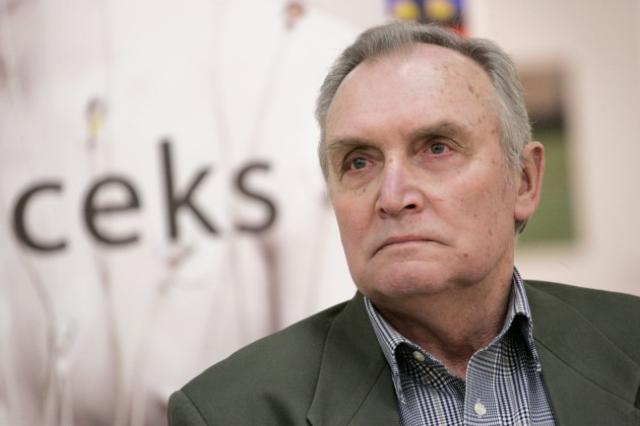
Uldis Dumpis
 Latvia
- A childhood shaped by war
- From conservatory to the National Theatre
- A screen presence audiences made their own
- Recognition and family life
- Legacy
For generations of Latvian audiences, Uldis Dumpis has been a familiar presence both on stage and on screen. His career stretches from the Latvian National Theatre to beloved films whose characters and lines have become part of everyday cultural memory. The actor’s appeal rests on a rare balance: he can appear steady and warmly ordinary, yet bring sharp irony, hidden vulnerability or comic mischief into a role. That range has made him one of Latvia’s most enduring performers.
A childhood shaped by war
Uldis Reinis Dumpis was born on 3 October 1943 in Bauska, Latvia, then under German occupation during the Second World War. His parents, Teodors Reinis Dumpis and Lilija Ramane, were university students. His father was drafted into the German army while still a young man and disappeared near the end of the war; Uldis never had the chance to know him. His mother, a trained philologist and philosopher who also studied music, worked as a music teacher and organist.
Dumpis’s early years were spent at the family homestead in Īslīce parish. Later, he and his mother moved to the Rundāle area and Bauska. He attended school in the region, graduating from Bauska Secondary School in 1961. Music and sport both held his attention: he studied piano and trumpet and played basketball. Those early experiences gave him a feel for rhythm and physical expression that would serve him onstage.
From conservatory to the National Theatre
After secondary school, Dumpis trained in acting at the Latvian State Conservatory, completing his studies in 1965. That year he joined the Latvian National Theatre, beginning a relationship with the company that would define his professional life. He became known for a strikingly broad stage range, moving from comedy to tragedy and from carefully observed character parts to leading roles.
His early performances already displayed a distinctive mix of intelligence, restraint and an eye for social character. Among the parts that became important in his theatrical career were Mitch in Tennessee Williams’s A Streetcar Named Desire, Liliom in Ferenc Molnár’s play, and the title role in Pāvils Rozītis’s Ceplis. He also took on major roles in works by Shakespeare, Gogol, Ibsen and Latvian playwrights. In later years he played Shylock in The Merchant of Venice, Prospero in The Tempest and Dobchinsky in The Government Inspector, showing that his repertoire kept growing well into his seventies.
His style could make comic characters sparkle through timing and improvisation, while in more serious parts he brought a thoughtful, sometimes guarded intensity. The National Theatre describes his stage range as running from comic performer to tragic hero. He was also active in radio theatre, where his expressive voice became another important part of his public career.
A screen presence audiences made their own
Dumpis began appearing in films in the mid-1960s, and over time became one of the most recognizable actors in Latvian cinema. One of his best-known roles was Ēriks Tūters in Jānis Streičs’s 1981 comedy-drama Limousine the Colour of Midsummer’s Eve. His portrayal of the worldly, self-assured relative helped make the character unforgettable. He also became widely loved as the father in Emīla nedarbi, and appeared in films including Pūt, vējiņi!, Vella kalpi vella dzirnavās and Baiga vasara.
Latvian audiences have long quoted scenes from films in which he appeared, and his characters became embedded in family life and popular culture. Yet the screen image of the dependable Latvian man only tells part of the story. Beneath the familiar warmth, Dumpis could be ironic, sly and emotionally complex. His film work has ranged from comedy and rural storytelling to historical drama and contemporary cinema, keeping him visible to new generations of viewers.
Recognition and family life
Dumpis’s contribution has been recognized by the Latvian state and cultural institutions. He is an officer of the Order of the Three Stars, Latvia’s highest state decoration, and in 1995 received the Alfreds Amtmanis-Briedītis Prize. On his eightieth birthday in 2023, President Edgars Rinkēvičs presented him with a Certificate of Merit for his lifelong dedication to the stage and his contribution to Latvian culture.
Away from the theatre, Dumpis has described himself as a country boy who finds rest in nature and practical work. He and his wife, television director and producer Daina Dumpe, built a large extended family. Their daughter Dace has four children, and the family gathers at their country home near Lake Raiskums. His grandchildren call him “O,” a name that grew from the way he used to answer a toddler’s call with an affectionate “ū-ū.”
Legacy
Uldis Dumpis’s career links Latvia’s postwar stage tradition with generations raised on Latvian film and television. His longevity at the National Theatre is matched by the continuing life of his screen roles, which audiences remember as if the characters were neighbors. He has remained a popular figure without being confined to a single type: the reliable family man on screen is only one facet of an actor equally at home with comedy, classical drama, psychological character parts and radio performance. In his work, warmth and precision have made an enduring combination.