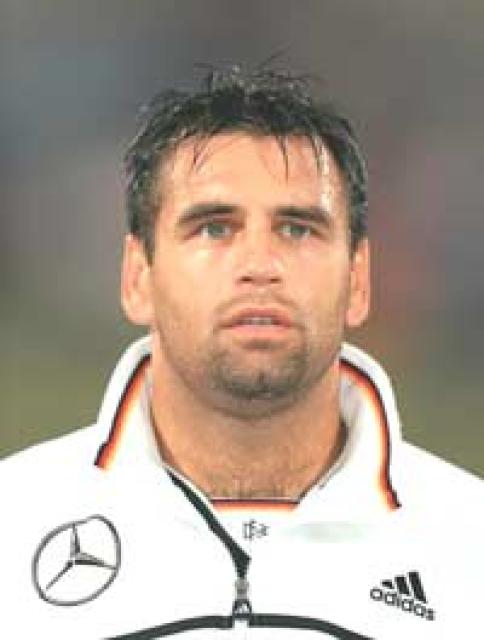
Ulf Kirsten
 Germany
Biography of Ulf Kirsten
Ulf Kirsten, a football player, is rightfully considered one of the best forwards of the late 20th century and early 21st century. For 20 years, he delighted fans with his game. His goals were milestones in the history of German, European, and world football. In the autumn of 2003, the famous striker played his farewell match in Dresden. It was time to sum up his career.
Early Life and Career
Ulf Kirsten was born on December 4, 1965, in Riza, German Democratic Republic (GDR). Riza was a small industrial city located 40 kilometers from Dresden, on the left bank of the Elbe River. Kirsten's childhood was shaped by the presence of two major factories in the city - a metallurgical plant and a chemical plant. With limited options for his future - either working at the factory, pursuing a political career, or playing sports - Kirsten chose sports, particularly football. The city had a well-developed sports infrastructure, with each factory having its own sports schools.
In the 1970s, football experienced a boom in the GDR and specifically in Riza. The city's main team, "Stahl," consistently played in the top league of the GDR championship, especially dominating at home games. The success of the Dresden-based team, "Dynamo," in European competitions also contributed to the growing interest in football. These games became a turning point in Kirsten's life. Inspired by Dynamo's performances in the UEFA Cup during the 1973/1974 season, Kirsten's dream was to become a football player and join Dynamo. His idols were midfielders Hans-Jürgen Kreische and Klaus Sammer (father of Matthias Sammer). Little did the boy from Riza know that it would be Klaus Sammer who would open the door to professional football for him a decade later.
At the age of seven, Kirsten joined the local football team of the Hemie sports club (an equivalent to the Soviet sports club "Khimik") under the guidance of his father. In 1978, he was invited to join the youth academy of "Stahl." Even at a young age, Kirsten caught the attention of his coaches due to his natural talent and frequently played for older teams. His standout performances in youth tournaments led to the attention of Dynamo Dresden's youth coaches. At the age of 14, Kirsten became a player for Dynamo Dresden, the team he had always dreamed of joining. Initially, he commuted to Dresden for training and school, but after a year, he moved to Dresden. In the Dynamo sports school, his skills rapidly developed, and he represented the national teams at various youth levels.
Club Career
Kirsten made his debut in the GDR Oberliga (top division) in the autumn of 1983. The new head coach of Dynamo, Klaus Sammer, began rebuilding the team, as the veterans who were associated with the successes of the 1970s were retiring. Kirsten quickly became an integral part of the team and was selected for the national team at a young age. In his first season, Dynamo Dresden finished second in the league and won the GDR Cup.
For the next few seasons, Kirsten established himself as a key player for Dynamo Dresden. He formed a formidable attacking partnership with Torsten Gütschow, and their combination was lethal for opposing defenses. Kirsten's goal-scoring ability, along with his determination and physical attributes, made him a valuable player for the team. He helped Dynamo Dresden secure several top positions in the league and achieve success in domestic cup competitions.
In the 1989/1990 season, Kirsten's final season with Dynamo Dresden, the team clinched the GDR championship and the cup. Kirsten was in top form, and his performances were recognized as he was named the best player in the GDR. Despite his success at Dynamo Dresden, Kirsten decided to move to Bayer Leverkusen in the summer of 1990.
At Bayer Leverkusen, Kirsten continued his goal-scoring prowess and became the club's all-time leading scorer. He was an integral part of the team that reached the final of the UEFA Champions League in 2002. Kirsten's performances earned him multiple individual accolades, including being crowned the top goal scorer in the Bundesliga and winning the title of best player in the GDR in 1990.
International Career
Kirsten also had a successful international career, representing both the GDR and Germany national teams. He made his debut for the GDR national team in 1985 and later became a key player. Kirsten played a total of 49 matches for the GDR, scoring 14 goals. After German reunification, he continued playing for the unified Germany national team, earning 51 caps and scoring 21 goals. Kirsten represented Germany in major tournaments such as the FIFA World Cup in 1994 and 1998 and the UEFA European Championship in 2000.
Legacy
Ulf Kirsten is widely regarded as one of the best forwards of his generation. His goals and performances left an indelible mark on German, European, and world football. Kirsten's technical skills, goal-scoring ability, and work rate made him a formidable striker throughout his career. His achievements, both at the club and international levels, cemented his status as one of the greats of the game.
After retiring from professional football, Kirsten remained involved in the sport as a coach and ambassador for the game. He continues to inspire future generations of football players with his achievements and contributions to the sport.


