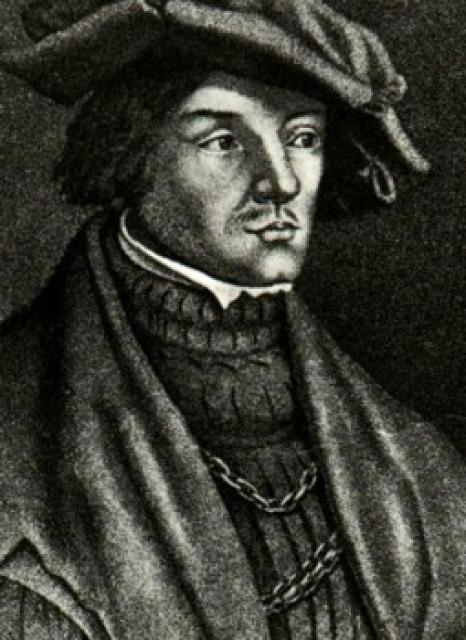
Ulirih Von Gutten
 Germany
- Biography of Ulrich von Hutten
- Early Years
- Friendship with Erasmus and Conflict
- Association with Martin Luther
Biography of Ulrich von Hutten
Ulrich von Hutten was a German writer and humanist. He was born on April 21, 1488, in the fortress of Steckelberg, near Fulda, Hesse, FRG. Coming from a noble but impoverished knightly family, Hutten was destined for a life as a monk. He received an excellent education at the school of the Benedictine monastery in Fulda, but lost his faith and became an irredeemable anticleric. Leaving the school in 1504, he chose the life of a wandering scholar.
Early Years
After a brief stay in Cologne and Erfurt, Hutten entered the newly founded university in Frankfurt-on-Oder, where he obtained an academic degree and published his first Latin poems, which continued to be published until around 1516. In 1511, Hutten published a treatise on the Art of Versification. He was in Pavia, Italy, studying law when the Swiss captured and sacked the city in 1512. He then moved to Bologna and was forced to enlist in military service in 1513. Hutten returned to Germany in 1514 and with the help of his relatives, gained the patronage of the new Elector of Mainz, Archbishop Albert of Brandenburg.
Friendship with Erasmus and Conflict
In 1514, Hutten met Erasmus of Rotterdam, who warmly received his works. A year later, Hutten's cousin, Hans von Hutten, was murdered by the Duke of Württemberg, Ulrich, and Hutten launched fierce attacks on the duke through his writings, later directing his anger towards all independent princes of the Holy Roman Empire. During this time, he became one of the authors of the famous "Letters of Obscure Men" (Epistolae obscurum vivorum), which were published from 1515 to 1517. These letters denounced the churchmen of Cologne, and Elector Albert, alarmed by Hutten's outspokenness, banished him from the court.
Association with Martin Luther
Hutten joined Martin Luther and became his friend and ally. He supported Luther's appeals to the common people and used Latin and German to vehemently expose the papacy and the Roman Catholic clergy. This led Emperor Charles V to withdraw his patronage, and Hutten fled from Germany to Switzerland. Sick and impoverished, he made his way to Basel, where Erasmus refused to meet him, dissatisfied with the lack of restraint in his later works. The rift between the two humanists escalated into a bitter feud. Hutten's further journeys eventually brought him to Zurich, where he found refuge on the island of Ufenau in Lake Zurich. There, Hutten died on August 29, 1523.


