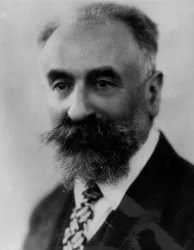
Ulrich Beck
- Early life and education
- The risk society
- Reflexive modernization and globalization
- Academic work and public debate
- Final years and legacy
Ulrich Beck became one of the most widely read sociologists of his generation by asking how modern societies create new dangers as they solve old problems. His idea of the “risk society” gave a name to the environmental, technological, and political uncertainties that cross borders and resist easy control. He extended that argument into a broader account of globalization, individualization, and the changing meaning of modern life.
Early life and education
Beck was born on 15 May 1944 in Stolp, then part of Germany and now the Polish city of Słupsk. His family moved to Hanover during his childhood. He initially studied law at the University of Freiburg, then transferred to the University of Munich, where he pursued sociology alongside philosophy, psychology, and political science.
He completed his doctorate in sociology in 1972 and qualified for a university professorship in 1979. Beck taught at Münster and Bamberg before returning to Munich in 1992 as a professor of sociology. His career also took him to the London School of Economics and the Fondation Maison des Sciences de l’Homme in Paris.
The risk society
Beck’s best-known book, Risk Society: Towards a New Modernity, appeared in German in 1986. It argued that advanced industrial societies were increasingly defined by the hazards produced by their own development. Industrial pollution, nuclear power, climate change, and other large-scale risks could affect people across national boundaries, while the institutions created to manage them often struggled to measure or contain them.
The concept made Beck’s work influential well beyond universities. He did not claim that older forms of poverty or class inequality had disappeared. Instead, he examined how modernity generated new uncertainties alongside persistent social divisions, and how those dangers were distributed unevenly.
Reflexive modernization and globalization
Beck developed the idea of “reflexive modernization” to describe a society confronting the unintended consequences of its own progress. Scientific knowledge, economic growth, and technology could bring new possibilities, but they could also expose dangers that challenged the institutions and assumptions behind modern life. He explored these changes in books including World Risk Society and What Is Globalization?
He also wrote about individualization: the way people in modern societies increasingly have to shape their own life paths as inherited roles and traditions weaken. In later work, he argued that social science and politics needed to look beyond the nation-state. Climate change, migration, and economic interdependence demanded what he called a cosmopolitan perspective, attentive to connections between societies.
Academic work and public debate
At Munich, Beck founded and led a major research program on reflexive modernization. He edited the journal Soziale Welt and helped bring sociological ideas into public debates about European integration, globalization, environmental change, and social inequality. His writing combined large-scale theory with accessible arguments, helping Risk Society reach readers in many languages and outside academic circles.
Beck’s theories also drew criticism. Scholars debated how far risks had displaced class as the defining feature of modern society, and whether his account placed too much weight on broad social transformations. Those debates became part of the book’s impact: it offered a framework that readers could apply, question, and refine.
Final years and legacy
Beck remained active in research until his death in Munich on 1 January 2015, aged seventy. In his later years, he studied climate change and developed a research program on methodological cosmopolitanism, asking how social science could understand problems that cross national borders.
His work left a lasting vocabulary for discussing the uncertainties of modern life. “Risk society,” “reflexive modernization,” and “cosmopolitanization” continue to shape conversations about technology, the environment, globalization, and political responsibility. Beck’s central challenge was to recognize that progress can produce dangers of its own—and that responding to them requires cooperation beyond the boundaries of any one country.