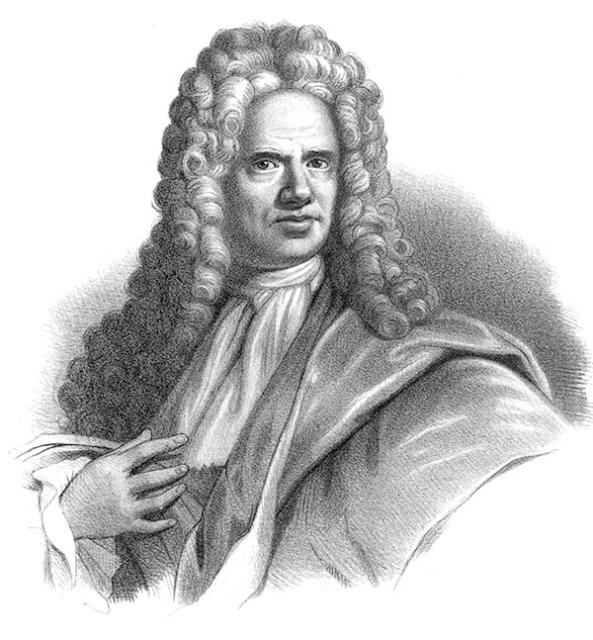
Urban Hjerne
 Sweden
- Early Life and Education
- Medical Practice in Riga
- Court Physician and Chemist
- Contributions to Mineralogy and Metallurgy
- Authorship and Legacy
Early Life and Education
Urban Hjärne was born into a Lutheran pastor's family in Skvoritsy, Ingria. His father became the vicar in Nyen in 1649, and the family moved there. Hjärne studied at Nienstadt town school. When the Russo-Swedish War broke out in 1655, his family fled to Narva. He continued his education at the Academia Gustaviana.
Hjärne completed his studies at Uppsala University in 1660, where he excelled in chemical experiments under the guidance of Olof Rudbeck the Elder. He then pursued natural sciences in France at the University of Angers, where he received his doctorate in medicine.
Medical Practice in Riga
From 1666 to 1669, Hjärne practiced medicine in Riga, where he advocated for humane treatment of accused witches and promoted scientific education. He played a key role in the establishment of the Riga Royal Lyceum (Schola Carolina) in 1675.
Court Physician and Chemist
In 1674, Hjärne moved to Stockholm and became the personal physician to King Charles XI. He was instrumental in reorganizing the Royal Chemical Laboratory and became its director in 1683. Hjärne's research focused on analytical chemistry and the study of minerals, ores, soil samples, and organic compounds. He developed a system of chemical analysis that became widely adopted.
Contributions to Mineralogy and Metallurgy
Hjärne made significant contributions to mineralogy and metallurgy. He discovered the mineral spring in Medevi, southern Sweden. He also advanced the mining industry and established the foundations of mineralogical science in Sweden.
Authorship and Legacy
In 1712, Hjärne published the first chemistry textbook in Sweden. His brother was the renowned Swedish historian Thomas Hjärne. Urban Hjärne's legacy as a pioneering chemist, metallurgist, and natural scientist laid the groundwork for Sweden's reputation in these fields.


