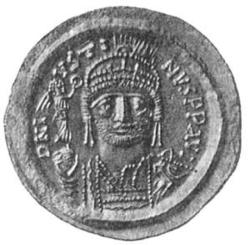
Ustinian II
 Greece
Biography of Justinian II
Justinian II Rhinotmetos, a Byzantine Emperor of the Heraclian dynasty, ruled in 685-695 and 705-711. He was the son of Constantine IV. Upon taking power, Justinian, according to Theophanes, disrupted all the conditions and agreements made by his father Constantine. In 688, he marched into Thrace against the Slavs and Bulgars. Initially, he was successful, driving out the Bulgars and capturing a large number of Slavs in Thessaloniki. He forced them, by force of arms and persuasion, to resettle in Asia Minor, near Abidos in the Opsikian district. However, on the return journey, the emperor was ambushed by the Bulgars in narrow mountain passes and suffered heavy losses, barely managing to escape with many casualties.
Justinian recruited a 30,000-strong army from the resettled Slavs, arming and equipping them in the Roman fashion. Relying on these forces, he sent a letter to the caliph stating that he no longer wished to maintain the written peace agreement. In 692, the emperor, along with Slavic troops and cavalry, went to Sebastopolis. The Arabs claimed that they did not violate the peace but were forced to do so by Justinian. Under the leadership of Muhammad, they attacked the Romans but were defeated. Muhammad then decided to act differently and secretly met with the Slavic leader Gebele, sending him a quiver filled with money and deceiving him with many promises, convincing him to defect with 20,000 Slavs. After this, Justinian ordered the remaining Slavs, along with their wives and children, to be put to death, and he retreated. Justinian treated his own subjects no better than his neighbors. He initiated many constructions and appointed Stephanos Persa, his secretary and the chief eunuch, as overseer of the works. Stephanos was a bloodthirsty and merciless man who not only cruelly tortured the workers but also stoned their supervisors. Once, in the emperor's absence, he dared to whip Empress Anastasia, Justinian's mother, as if flogging children with a switch. He also mistreated the people and made the emperor's name hated.
In the position of the Count of the Generals, Justinian appointed an abbot named Theodosius, who had previously lived as a hermit in the Thracian mountains. This poor and excessively cruel man, demanding accounts, taxes, and collections, hanged and burned many government officials, nobles, and famous people. He also did the same to many private citizens, torturing them without cause or pretext. In addition, by the emperor's order, the city officials imprisoned many people and forced them to languish there for many years. All of this increased the people's hatred for the emperor. Meanwhile, Justinian demanded that Patriarch Callinicus hold a prayer service for the destruction of the Church of the Holy Virgin, located near the palace, in order to build a pavilion and lodgings for circus parties from Venice, where they could entertain the emperor. The patriarch responded: "We serve prayer services for the construction of churches and have no prayer services for their destruction." However, the emperor insisted, and the church was destroyed.
Taking advantage of the widespread dissatisfaction, the general Leontius overthrew Justinian in 695 and, cutting off his nose and tongue, sent him into exile in Chersonesus. The despised Stephanos and Theodosius were burned alive in the Forum of the Bull. The deposed emperor quietly lived in Crimea until 698. But upon learning of the overthrow of Leontius by Tiberius III, he regained his spirit and announced to the people of Chersonesus that he was going to reign again. The residents, fearing the danger from the empire, decided to either kill Justinian or hand him over to Tiberius. After hearing about this, he escaped and, reaching Dara, demanded a meeting with the Khagan of the Khazars. The Khagan received Justinian with great honors, took him under his protection, and gave him his sister Theodora in marriage. After some time, Justinian, having obtained permission from the Khagan, left for Phanagoria and lived there with his wife. Tiberius, in the meantime, entered into negotiations with the Khazars and promised the Khagan many gifts if he would send him Justinian alive or at least his head. The Khagan eventually yielded to his requests and sent guards to Justinian under the pretext of protecting him from his own tribesmen, but ordered Papatzes, who was in Phanagoria on his behalf, and Valgitz, the archon of the Bosporus, to kill Justinian as soon as they received the order. However, when Theodora was informed of this through a servant of the Khagan, Justinian learned about it. He invited Papatzes for a private conversation and strangled him with a rope. He then killed Archon Valgitz in the same way. He sent Theodora to Khazaria and fled from Phanagoria to Tomis. There he found a fishing boat, and Justinian sailed on it to Symbola, located near Chersonesus. From there, he secretly sent for his friends and sailed further west. Near the mouth of the Dniester, the ship was caught in a storm, and everyone had given up hope of survival. Then Miak, the emperor's servant, said, "Master, we are perishing. May God vow in your name not to punish any of your enemies if He saves you." But Justinian angrily replied, "May God condemn me to drown in this place if I spare any of them." He emerged unharmed from the storm and reached the Danube. He sent his friend Stephanos to the Bulgarian Khan Tervel to ask for his assistance in reclaiming his ancestors' empire and promised Tervel many gifts and his daughter in marriage. Tervel received Justinian with honors, declared him Caesar, seated him next to himself, and ordered the people to kneel before both of them. Then, after showering him with rich gifts, Tervel sent him back. Justinian blinded and exiled Patriarch Callinicus for dishonoring him and proclaiming Leontius, instead installing Kiry as the patriarch who, during his exile, had predicted Justinian's second reign. Justinian committed numerous killings and atrocities against his subjects. He appointed some to be archons and immediately sent others to follow them and kill them. He invited others to a dinner and poisoned them. He drowned others in sacks in the sea. By unanimous accounts, he was an extremely cruel beast to his subjects. He sent for his wife Theodora and their son Tiberius from Khazaria and crowned them as rulers. After that, in 710, he broke the peace with the Bulgars and led a large army into the Thrace region, launching a war against them near the city of Anchialus. However, the Bulgars, unexpectedly for the scattered army that was dispersing in the plain to gather provisions, attacked and killed many of them, taking others captive. The emperor himself, staying in Anchialus, was besieged for three days. He managed to escape at night, boarded a ship, and fled. He later arrived in Constantinople (Theophanes: 680, 683, 686, 687, 696).
After dealing with his enemies in the capital, Justinian decided to punish the inhabitants of Chersonesus and the Bosporus for their conspiracy against him. In 710, he assembled a large fleet funded by the residents of Constantinople, appointed Patrikios Stephanos to lead it, and ordered him to slay all the inhabitants of Chersonesus with the sword, leaving no one alive. The Romans, upon arriving in Chersonesus, captured the fortress as no one resisted them and killed everyone with the sword except for the teenagers. Stephanos, leaving Spapharius Ilya as the archon in the city, embarked on the ships and sailed back. However, the fleet was caught in a storm, and almost all of it sank. When Justinian learned of this, he was not at all saddened but, on the contrary, became even more filled with joy and madness. He announced that he would send a second army, destroy Chersonesus, and level it to the ground. In response, the people of Chersonesus sought the protection of the Khazar Khan. Spapharius Ilya incited a rebellion and proclaimed the Armenian Vardan, whom they renamed Philippicus, as emperor. Justinian, in his fury, slaughtered the children of Ilya on their mother's breast and forced her to marry her Indian-born cook. Subsequently, the emperor assembled a second fleet under the command of Patrikios Maurus, equipped with rams and siege engines, and ordered him to demolish the walls of Chersonesus and the entire city, leaving no one alive. As soon as Maurus arrived, he destroyed two towers with a ram, but then the Khazars appeared, and the war ceased (Theophanes: 703). Patrikios Maurus, not knowing how to continue the siege and at the same time fearing to return to Justinian, defected to the side of the Chersonesites and Philippicus (Theophanes: 711). Since the fleet was delayed, and no letters reached the emperor, he went to Sinope, closer to Chersonesus. Meanwhile, Philippicus arrived in the capital and took control of the city without resistance. Justinian, along with his army, arrived later and stayed in Damastris. Philippicus sent Spapharius Ilya against him, who entered into negotiations with the imperial troops and promised them all safety. All the soldiers fled from Justinian, leaving him alone, and sided with Philippicus, while Ilya rushed at Justinian with fury, grabbed him by the neck, and decapitated him with a sword. They sent the imperial bodyguard John to capture Justinian's son Tiberius. They captured him as he fled to the altar of the Church of the Holy Virgin. John pulled the boy, who clung to the holy cross, out without regard for the sanctity of the altar or the abundant tears of his grandmother Anastasia, who was in danger together with him, and killed him behind the wall on paper. Many of Justinian's close associates were also killed. Such was the end of the Heraclian dynasty (Theophanes: 711).