Manuil Komnin
 Italy
ItalyBiography of Manuel Komnenos
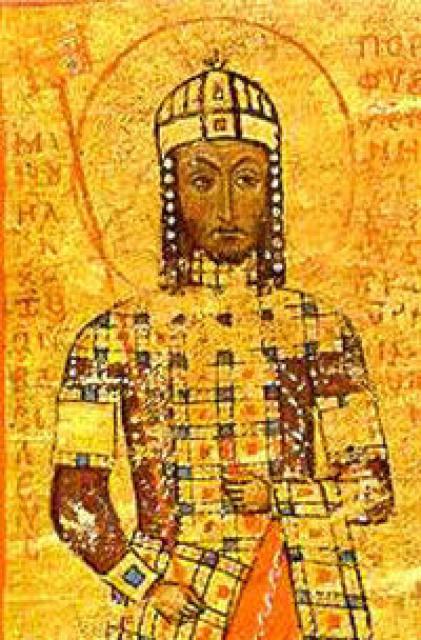
Manuel Komnenos was the Byzantine Emperor from 1143 to 1180. During his reign, he led two campaigns in Asia Minor to protect Byzantine territories from the attacks of the iconoclastic Turks and secured a favorable peace treaty with them. He also formed an alliance with Emperor Conrad III upon his return from the Second Crusade, in order to jointly combat the Sicilian King Roger II. Manuel successfully defended against Roger's invasion, reclaiming the island of Corfu and defeating the Norman fleet.
In addition to his military campaigns, Manuel engaged in wars against the Dalmatians and Serbs. By 1150, he had the Serbs acknowledge his suzerainty. His conflict with the Hungarians lasted until the late 1160s, resulting in the Byzantines conquering parts of Dalmatia and several Hungarian cities. After Roger's death, Manuel renewed his fight against the Sicilians and managed to gain control over significant portions of southeastern Italy, including Brindisi and Bari. However, in 1156, the new Sicilian King William inflicted a devastating defeat on the Byzantines near Brindisi, undoing Manuel's Italian gains.
Manuel had ambitions of establishing political supremacy in the West and sought alliances with Italian maritime cities such as Venice, Genoa, and Pisa. Initially, he pursued diplomatic relations, but eventually engaged in a struggle against Frederick Barbarossa. Manuel defended Pope Alexander III against Frederick, succeeding in restoring him to the papal throne. However, the alliance between Manuel and the Pope eventually dissolved. The Venetians, who lived within the Byzantine Empire, repeatedly violated Manuel's demands, leading him to arrest all Venetians and confiscate their property in 1170. Although the Venetians' attempts to instigate a rebellion against Byzantium did not yield significant results, their actions contributed to a growing discontent in the empire.
In the East, Manuel planned to conquer Egypt in collaboration with King Baldwin IV of Jerusalem. However, their campaign ended in failure. Manuel's grand plans, which were unrelated to the immediate needs of the empire, such as defending its borders against Slavs in Europe and Turks in Asia, exhausted the empire's resources. These plans also strengthened the influence of "Latins" (Westerners) and sparked a strong anti-Western reaction in Byzantium towards the end of Manuel's reign.
In 1176, Manuel launched a military campaign against the Turks in Asia Minor. However, he suffered a disastrous defeat at the Battle of Myriokephalon, near Iconium. The Turks ruthlessly defeated the Byzantines, and Manuel himself was wounded and almost captured. He was forced to sign a peace treaty with the Iconium Sultan, agreeing to demolish two fortresses he had recently rebuilt to deter the Turkish incursions. The failure to fulfill this obligation led to further Turkish attacks, devastating the Meander Valley and reaching as far as the Archipelago. This further deepened the negative perception of Manuel's policies.
By the end of his life, Manuel lost interest in politics and became engrossed in astrology. He retired to a monastic life before his death. Manuel Komnenos was undoubtedly a talented emperor, representing a unique combination of refined Byzantine culture and Western knightly tastes and manners. However, his brilliant reign ultimately drained the resources of both the government and the people, leaving the state vulnerable to external enemies. This explains the abrupt shift in Byzantine policy that occurred after Manuel's death.