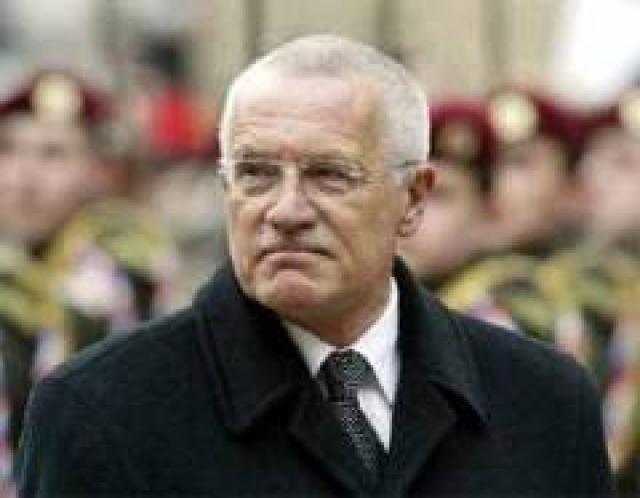
Vaclav Klaus
 Czech
Czech- Biography of Václav Klaus
- Early Life and Education
- Professional Career
- Political Career
- Presidency and Legacy
- Personal Life
Biography of Václav Klaus
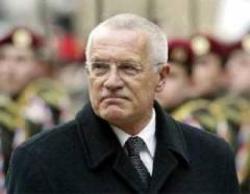
Václav Klaus, the former President of the Czech Republic, is known as one of the "fathers" of the country's economic reform and the author of the theory of "coupon" privatization. According to Czech political analysts, he is characterized by pragmatism and scientific analytical thinking.
Early Life and Education
Václav Klaus was born on June 19, 1941, in Prague. He graduated from the Higher School of Economics in Prague in 1963 with a specialization in foreign trade. He furthered his education by completing internships in Italy and at Cornell University in the United States in 1966 and 1969, respectively.
Professional Career
From 1963 to 1970, Klaus worked as a research fellow at the Economic Institute of the Czechoslovak Academy of Sciences (ČSAV). However, he was dismissed from his position due to his critical views on the policies of the Communist Party of Czechoslovakia. Subsequently, Klaus worked at the State Bank of Czechoslovakia from 1971 to 1986. In the late 1980s, he became a leading research fellow at the Institute of Forecasting of the ČSAV.
Political Career
Václav Klaus entered the world of politics in November 1989 as an activist of the mass political movement called "Civic Forum" (Graždanský fórum). He was a member of the coordination center of the Civic Forum and later served as its chairman from 1990 to 1991. From December 1989 to July 1992, Klaus held the position of Minister of Finance in the Czech and Slovak Federative Republic (ČSFR) government under Prime Minister Marián Čalfa. He represented the interests of the ČSFR in the World Bank and the European Bank for Reconstruction and Development. From December 1991 to July 1992, Klaus served as the Deputy Prime Minister. After the dissolution of the ČSFR, he became the Prime Minister of the Czech Republic and held the position until November 1997.
During the 1990s, Václav Klaus was elected as a member of parliament multiple times, and from 1998 to 2002, he served as the Speaker of the Chamber of Deputies (lower house of parliament). In 1991, Klaus founded and led the Civic Democratic Party (Občanská demokratická strana, ODS), serving as its chairman for over ten years until December 2002. He currently holds the honorary position of Honorary Chairman in the party.
Presidency and Legacy
On February 28, 2003, Václav Klaus was elected as the President of the Czech Republic. During his presidency, Klaus continued to advocate for economic reforms and played a significant role in the country's political landscape. He is widely regarded as one of the key figures in the reform of the national economy and the architect of the "coupon" privatization theory. Czech political analysts praise him for his pragmatism and scientific analytical thinking.
Personal Life
Václav Klaus is married to Livie, who works at the Economic Institute of the Czech Academy of Sciences. They have two sons, Václav and Jan. Despite recently becoming a grandfather, Klaus is still known as the most athletic politician in the country. He enjoys skiing, playing tennis, and volleyball. Additionally, he is fluent in Russian.