Jindrich Bretislav III
- Early Life and Ecclesiastical Career
- Conflict with Secular Authority
- Accession to the Throne
- Reign and Opposition
- Consolidation of Power and Later Years
- Legacy
Early Life and Ecclesiastical Career
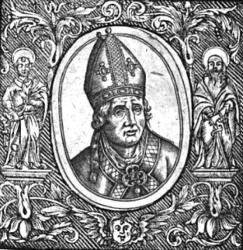
Henry Bretislav was born into the Přemyslid dynasty, the son of Henry, a Czech prince and nephew of King Vladislav II. His education took him to Paris, where he was ordained as the Bishop of Prague in 1182.
Conflict with Secular Authority
Bishop Bretislav was an ambitious figure who sought to diminish the authority of the secular prince over the Prague diocese, including the obligation to pay taxes. He excommunicated his cousin, Duke Děpolt II, in 1186, prompting Duke Frederick to intervene on Děpolt's behalf. Bretislav challenged Frederick's actions before Emperor Frederick Barbarossa, who summoned the duke to Regensburg. When Frederick refused to appear, Bretislav was granted imperial protection that freed the diocese from secular interference.
As a symbol of his defiance, Bretislav constructed a formidable Romanesque castle at Roudnice nad Labem, the first such fortress built by anyone other than the Czech prince.
Accession to the Throne
Upon the death of Duke Conrad II Otto in 1191, Bretislav supported his cousin, Přemysl Otakar I, in the struggle for succession against Wenceslas II. He traveled to see Emperor Henry VI in 1192 and promised to pay 6,000 marks of silver in exchange for the Czech throne for Přemysl. When Bretislav failed to deliver the promised bribe, the emperor prevented his attempted flight to Santiago de Compostela and forced him to return to Bohemia.
In 1193, Henry VI finally deposed Přemysl Otakar and granted the Czech throne to Bretislav, who had offered a staggering 6,000 talents of silver. Bretislav thus became the first person to hold both spiritual and temporal power in Bohemia.
Reign and Opposition
Bretislav's authority was challenged by Přemysl Otakar, who fled into exile and raised an army. However, the nobility ultimately abandoned Přemysl and pledged allegiance to Bretislav. Only the citizens of Prague remained loyal, defending the city until Christmas. Přemysl Otakar was forced to flee the country.
Consolidation of Power and Later Years
Bretislav steadily consolidated his power, capturing and imprisoning his last opponent, the Moravian Margrave Vladislav Henry. He supported the emperor in his conflicts and participated in an ill-fated Crusade. By 1197, he was seriously ill.
With the arrival of Papal Legate Cardinal Peter of Capua in Prague, Bretislav sought to restore celibacy among the clergy. However, Přemysl Otakar seized this opportunity to invade Bohemia. Forced to retreat to Cheb, Bretislav died there on June 15, 1197.
Legacy
Bretislav was buried in the Doksany Monastery, where his sister served as abbess. Despite his controversial reign, he was a significant figure in Bohemian history, consolidating the relationship between church and state and leaving a lasting architectural legacy in the castle at Roudnice nad Labem.