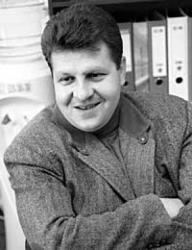
Valentin Vologdin
- Early Life and Education
- Revolutionary Activism and Technological Innovations
- Contributions to Radio Technology
- High-Voltage Rectifiers and Industrial Applications
- Legacy and Recognition
Early Life and Education
Valentyn Petrovich Volodyn was born on March 22, 1881, in the village of Rozhdestvenskoye, Perm Oblast, to a former serf family of the Stroganov industrialists. Inspired by his father's love for carpentry, mechanics, and reading, Volodyn pursued his education with zeal. In 1892, he joined the Perm Real School, where his passion for physics was ignited.
Revolutionary Activism and Technological Innovations
In 1900, Volodyn enrolled at the St. Petersburg Technological Institute, where he excelled academically. However, his involvement in student demonstrations led to his arrest and eventual expulsion from the university. Despite the setback, he continued his studies in engineering while serving in the army.
Contributions to Radio Technology
After graduating from the Technological Institute in 1907, Volodyn worked at the "Electromechanical Plant N. Glebov and Co." as head of the testing station. His expertise in electrical machinery led him to propose replacing batteries with high-frequency dynamos in radio stations. This innovative solution improved transmitter efficiency, simplified operation, and enhanced reliability.
High-Voltage Rectifiers and Industrial Applications
Volodyn also developed the first high-voltage mercury rectifiers, revolutionizing the field of electronics. He explored the use of high-frequency currents for metalworking processes such as melting, soldering, and surface hardening. Through his work, Volodyn played a crucial role in reducing foreign dependency in the domestic radio technology industry.
Legacy and Recognition
Volodyn's pioneering contributions to radio technology earned him the title of Corresponding Member of the USSR Academy of Sciences and made him one of the founders of the Nizhny Novgorod Radio Laboratory. His tireless efforts and unwavering passion for scientific innovation left an enduring legacy in the field of high-frequency engineering.