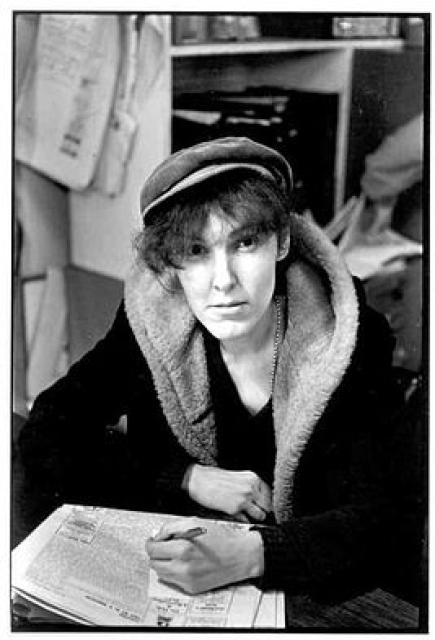
Valeri Solans
 USA
USAValerie Solanas: A Biography
Valerie Jean Solanas was born on April 9, 1936, in Ventnor, New Jersey, to Louis and Dorothy Bondo Solanas. Her father sexually abused her, and in 1940, her parents divorced. Valerie and her mother moved to Washington, D.C. In 1949, her mother married Red Morgan. Valerie, a stubborn and rebellious teenager, refused to attend a Catholic school and was physically punished by her stepfather. At the age of 15 in 1951, Valerie found herself alone. She became involved with a sailor, got pregnant, but still managed to complete high school in 1954. She excelled academically at the University of Maryland, College Park, while working in the biological laboratory of the psychology department. She then spent almost a year writing a psychology thesis at the University of Minnesota. After completing her studies, Solanas resorted to begging and prostitution to support herself. She traveled around the country and settled in Greenwich Village in 1966. It was there that she wrote the play "Up Your Ass," about an "energetic panhandler-misogynist." In one version, a woman kills a man, while in another, a mother strangles her son.
In early 1967, Solanas approached Andy Warhol at The Factory and offered him her play "Up Your Ass," giving him a copy of the manuscript. However, Warhol reportedly said, "The title sounded great, and I was in a good mood, so I agreed to produce it, but the play was so dark that I thought, maybe she's a cop... We haven't seen her since, but I'm not surprised. I guess she decided it was very Andy Warhol." Around the same time, she self-published her own mimeographed copies of "SCUM Manifesto," a radical feminist text, and sold them on the streets. She met Maurice Girodias of Olympia Press, who paid her an advance for a novel based on the manifesto. With the $600 she received, she traveled to San Francisco.
During this time, Ultra Violet showed Warhol the SCUM Manifesto, and he remarked, "She's a nut with tits. You know, she's writing a screenplay for us. She has a lot of ideas." Later, in May 1967, after Warhol returned from France and England, Solanas demanded her manuscript back. Warhol claimed to have lost it. Apparently, Warhol had no intention of producing "Up Your Ass" as a play or film; the manuscript got lost among other unread texts and papers scattered around The Factory. Solanas began harassing Warhol with continuous phone calls demanding money for her play.
In July 1967, Warhol paid Solanas $25 for a role in "I, a Man," a feature film he was making with Paul Morrissey. She played herself, a rough lesbian who rejects the advances of a real stud, stating that her instincts tell her to chase women and why should her desires be any less important than his? Solanas also appeared wordlessly in Warhol's film "Bike Boy." Warhol was impressed with her candid and amusing performance, and Solanas was happy enough to bring Girodias to a rough cut of the film. Girodias noted that Solanas "was quite free and friendly with Warhol, and their conversation consisted of long pauses."
In the fall of 1967, at a New York cafe called "Kansas City," Warhol noticed Solanas sitting at a nearby table. His greeting, "Hey, dyke! You're disgusting," led to an exchange of insults with Ultra Violet. Solanas began recounting her experiences of sexual abuse by her father. Ultra Violet responded with a harsh remark, "No wonder you're a lesbian." In the winter of 1967-68, Solanas gave an interview to Robert Mamoulian of The Village Voice. However, the article titled "Valerie Solanas: The SCUM Goddess" was not published until June 13, 1968, after the shootings. Solanas spoke about men's interest in SCUM, stating, "...idiots. Masochists. They'll probably enjoy it if I spit on them. They won't get that satisfaction... These guys want to kiss my feet and all that crap." She also spoke about women and sex, saying, "Girls are okay. They try to help as best they can. Although some are only interested in sex. That is, sex with me. I don't like being bothered... I'm not a lesbian. I don't have time for any kind of sex. It's a waste." She told Mamoulian that Warhol was a son of a bitch: "You can't feed a snake on what he paid me."
Solanas also shared details about her life. She surfed in her early youth and even sold an article about it to a magazine. "I had some funny adventures with strange guys in cars." According to the interview, she wrote several explicit sexual novels and received $500 for one of them. (Could this be the same novel based on the SCUM Manifesto?) She was interviewed on a talk show hosted by Alan Burke, but when she refused to watch her language, he walked off the set. The interview never aired.
As Paul Morrissey said in an interview with Taylor Mead, the contract Solanas signed with Olympia Press was just a "pathetic scrap of paper, a little note, only two sentences long. In it, Maurice Girodias wrote, 'I'll give you five hundred dollars, and you'll give me your next manuscript and all subsequent ones.'" Solanas understood this to mean that Girodias would own everything she wrote. She told Morrissey, "Oh no, everything I write will belong to him. He tricked me!"
Morrissey believed that Solanas was incapable of writing a novel based on the SCUM Manifesto, and she used the fact that he owned all her works as an excuse. Solanas seemed to believe that Warhol, by appropriating "Up Your Ass," wanted Girodias to steal all her works for Warhol, who didn't want to pay her, so she demanded a contract with Girodias.
In the spring of 1968, Solanas approached the publisher of the underground newspaper "The Realist," Paul Krassner, seeking money to shoot Maurice Girodias. He gave her $50, which she used to buy a .32 caliber automatic pistol.
On June 3, 1968, at 9 a.m., Solanas went to the Hotel Chelsea, where Maurice Girodias lived; she asked about him at the front desk and was told he had gone away for the weekend. Nonetheless, she stayed there for three hours. Around noon, she went to The Factory, which had just moved to a new location, and waited for Warhol outside. Paul Morrissey met her at the entrance and asked what she was doing there. "I'm waiting for Andy to give me money," she replied. To get rid of her, Morrissey said that Warhol would not be coming today. "That's okay, I'll wait," she said.
At around 2 p.m., she took the elevator up to the studio. Morrissey told her again that Warhol wouldn't be coming and that she couldn't stay. She left. She then rode the elevator up seven more times until she finally appeared with Warhol at 4:15 p.m. She was wearing a black turtleneck sweater, a coat, and had her hair done and makeup on, with painted lips, and carried a paper bag. Warhol even remarked, "Look, Valerie looks good!" Morrissey offered to make her leave, saying, "...We have things to do, and if you don't go, I'll blow your brains out and throw you out, and besides, I don't want to..." At that moment, the phone rang. Morrissey answered it; it was a call from Viva. Morrissey apologized and went to the bathroom. While Warhol was on the phone, Solanas shot him three times. Between the first and second shots, both of which missed, Warhol cried, "No! No! Valerie, don't do it!" The third bullet went through Warhol's left lung, spleen, liver, esophagus, and right lung.
While Warhol lay in a pool of blood, Solanas fired twice at Mario Amaya, an art critic and curator who was waiting to meet Warhol. She hit him in the right thigh with the fifth shot, and he ran out of the room to the back studio and slammed the door. Solanas turned to Ted Hughes, Warhol's manager, put the gun to her own head, and pulled the trigger, but the gun jammed. At that moment, the elevator doors opened, and no one was inside. Hughes said, "Look, the elevator's here. Why don't you take a ride, Valerie?" She replied, "That's a good idea," and left.
Warhol, in critical condition, was rushed to Columbus-Cabrini Hospital, where five doctors operated on him for five hours to save his life.
That same evening, at 8 p.m., Solanas turned herself in to a rookie cop directing traffic in Times Square. She said, "The police are looking for me. They want to arrest me." She then took out a .32 caliber automatic pistol and a .22 caliber pistol from her pockets and handed them to the police officer. Right there, she confessed to shooting Andy Warhol and explained her reason: "He had too much control over my life."
A crowd of journalists and photographers, shouting questions, awaited Solanas when she arrived at the 13th Precinct police station. When asked why she did it, she replied, "I have many reasons. Read my manifesto, and it will tell you who I am." Solanas had her fingerprints taken and was charged with assault and weapons possession.
Later that evening, Valerie Solanas appeared before Manhattan Criminal Court Judge David Garth. She told the judge, "I don't shoot people often. I did it deliberately. Warhol had tied me up by the hands and feet. He was going to do something that would have destroyed me."
When asked if she could hire a lawyer, she responded, "No, I can't. I want to represent myself. It should be within my competence. I did the right thing! I have no regrets!" The judge struck her remarks from the record, and Solanas was sent to Bellevue Hospital for psychiatric evaluation.
On June 13, 1968, Valerie Solanas appeared before Supreme Court Justice Thomas Dickens, represented by radical feminist attorney Florence Kennedy, who referred to Solanas as "one of the brightest stars of the feminist movement." Kennedy sought a court order for Solanas's release, claiming that she had been unjustifiably held in a psychiatric ward, but the judge denied the request and sent Solanas back to Bellevue. Ti-Grace Atkinson, president of the New York chapter of the National Organization for Women, was present at the hearing and declared Solanas the "first outstanding champion of women's rights."
On June 28, Solanas was formally charged with attempted murder, assault with a deadly weapon, and illegal possession of firearms. In August, she was declared unfit to stand trial and was sent to Ward's Island Hospital.
In August 1968, Olympia Press published "SCUM Manifesto," accompanied by essays written by Maurice Girodias and Paul Krassner.
On Christmas Eve, Solanas called Warhol at The Factory, threatening to shoot him if he didn't pay her $200,000 for her manuscripts so she could defend herself in court. She demanded that he drop all charges against her, stop featuring her in his films, and bring her on The Tonight Show with Johnny Carson. Solanas stated that if Warhol didn't comply, "she could always do it again."
In June 1969, Valerie Solanas was sentenced to three years in prison for "maliciously assaulting with intent to harm," with credit for the year she spent in a psychiatric clinic. Warhol's refusal to testify against her is believed to have influenced the reduced sentence.
Solanas was released from the Bedford Hills Correctional Facility for Women in September 1971. She was arrested again in November 1971 for sending threatening letters and making phone calls to various people, including Andy Warhol. In 1973, Solanas was repeatedly admitted to psychiatric hospitals, and in 1975, she spent eight months at South Florida State Hospital.
On July 25, 1977, journalist Howard Smith interviewed Valerie Solanas. She claimed to be working on a new book about her life and "all that crap" called "Valerie Solanas." According to her, she was supposed to receive a $100 million advance from members of what she called "The Gang," whom she referred to as "Money Guys." She continuously mentioned the "Contact Man" from this organization.
In the interview, she discussed the Society for Cutting Up Men: "It's a hypothetical society. No, 'hypothetical' is not the right word. It's just a literary device. SCUM does not exist as an organization. It's just women with a certain state of mind who are in SCUM. Men with a certain state of mind are in the male support group of SCUM."
She also refuted Smith's statement from 1968: "Where you say, 'She's not a lesbian, she's a man-hater... I think that was absolutely illegal. Because I was a lesbian... Although I didn't want sex at the time, I was interested in many other things... you know, the way it was said made it sound like I was a heterosexual..."
In the following issue of The Village Voice on August 1, 1977, another article by Howard Smith titled "Valerie Solanas Responds" was published. In it, Solanas corrected misinterpretations from the previous interview. She claimed that there were inaccuracies in the publication of the SCUM Manifesto by Olympia Press, stating that "words, and even big chunks of sentences, were missing from the text, making whole paragraphs read incoherently." She also claimed that The Voice had refused to publish the "Contact Man's" address, which she considered a crucial part of the interview. She called Smith immoral from a journalist's point of view and stated, "I'm guided by absolute moral standards"... Smith asked, "Valerie, wouldn't you like to discuss now how people are shot?" Solanas replied, "I consider that a moral act. And I consider it immoral that I missed. I should have practiced shooting."
In 1977, she also sent an incoherent letter to Playboy, theorizing that the editor was the "Contact Man" of "The Gang."
After that, Solanas's whereabouts were unknown until November 1987, when Ultra Violet tracked her down in Northern California. When Ultra Violet called her, Solanas had nothing to say.
On April 26, 1988, lonely and impoverished, Valerie Solanas died of emphysema and pneumonia at a low-income hotel in the Tenderloin district of San Francisco. She was 52 years old, a drug addict, and still worked on the streets. Prostitutes who knew her during those times claimed that she appeared slender and elegant, always wearing a silver brocade dress for her street work.
On January 14, 1991, an article titled "Andy Warhol's Feminist Nightmare" by Roman Gaiter was published in New York magazine. Gaiter interviewed Dorothy Moran, Solanas's mother, who denied much of what had been written about Valerie's later years: "Solanas led a quiet life in New York in the seventies and later in Phoenix and San Francisco. 'I think she had good friends, and that helped her.'" Moran denied that Solanas was frequently in psychiatric hospitals in the 1970s: "She wrote. She considered herself a writer, and she had some good friends. She was pretty much okay."


