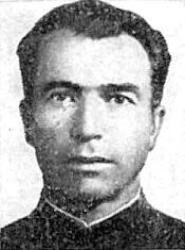
Valeriya Homyakova
 Russia
- Biography of Valeria Khomyakova
- Early Life and Education
- War Life and Achievements
- From the archives of the 586th Fighter Aviation Regiment:
- From an essay by Irina Chugunova, a student at a middle school:
Biography of Valeria Khomyakova
Valeria Khomyakova was a fighter pilot and a participant of the Great Patriotic War from February 1942. She fought as part of the 586th Women's Fighter Aviation Regiment of the Air Defense Forces and served as the deputy commander of a squadron. On September 24, 1942, she became the first woman to shoot down an enemy aircraft (a Junkers-88 bomber) in a night battle. She was born in Moscow in 1914, into a family of an engineer-chemist. Following in her father's footsteps, she graduated from the Mendeleev Chemical Institute. After completing her aeroclub training, she worked as a pilot-instructor.

Valeria Khomyakova was a charming and skilled aviator. In the sky, she showed courage and flying mastery. Many of these female pilots did not live to see the bright Day of Victory and did not return from their flights. But they left their mark on the ground. One of these pilots was Valeria Khomyakova, who tragically died in an aviation accident near Saratov in September 1942.
Early Life and Education
Valeria Khomyakova was born and raised in Moscow. She attended School No. 32 and was involved in sports. At the age of 17, she became a student at the Chemical Technological Institute. In 1937, she graduated with honors. During her student years, she enthusiastically participated in glider clubs and, while working at one of the city's factories, studied at an aeroclub. The call of the sky became stronger, and her dream led her to the Central Aeroclub, where she became a pilot-instructor.
Marina Pavlovna Chechnyova, a renowned pilot and Hero of the Soviet Union, remembers Valeria Khomyakova: "Valeria Khomyakova was a wonderful teacher and my reliable colleague at the aeroclub. As one of the best female pilots in Osaviakhim, she was always selected for air parades and entrusted with the most responsible parts of the program. As a person, Valeria was incredibly pleasant. She was full of joy for life and her tireless energy could infect everyone around her. She was admired for her composure and ability to prioritize her goals."
War Life and Achievements
The war separated our paths. I became a "night bomber," while Khomyakova, with her brilliant piloting skills, was assigned to the 586th Fighter Aviation Regiment. The formation of three female aviation regiments was led by the famous aviator Marina Raskova. At the training center in Engels, no one knew which regiment they would join. However, Valeria had already decided for herself: "I will only be a fighter pilot!" Her strong will was evident in this beautiful and slender young woman.
The selection process for the fighter regiment was rigorous. The Yak-1 aircraft, the best fighters of that time, were being assigned to them. Khomyakova demonstrated excellent piloting skills during the selection process. The commission was meticulous and strict, but observing how precisely and beautifully Valeria performed the most advanced aerobatic maneuvers, Colonel Bagaev, a member of the commission, said: "She will be a fighter pilot!" The path to combat readiness was tough, but Valeria never mentioned the difficulties in her letters to her family. Her letters were concise, always full of cheerfulness and optimism. She wrote, "I'm learning a lot of new and interesting things in theory and practicing shooting." And she rejoiced, "I can't wait to fly on those planes, what a dream!"
The day of her first combat mission finally arrived... N. Slovokhotova reminisces:
"In the spring of 1942, our 586th Fighter Aviation Regiment, well-trained and equipped with brand new "Yaks," entered the battle formations. When the German troops advanced towards Stalingrad, we were tasked with providing air cover for the strategically important city of Saratov. Valeria Khomyakova was one of the first to go on combat missions. By that time, she had been appointed as the deputy commander of a squadron.
Valeria was not only an excellent pilot but also a strong leader and educator. These qualities were already evident during her time at the aeroclub. Khomyakova's students became valuable additions to military flight schools. The command of the Borisoglebsk Military Pilot School often sent their gratitude to Instructor Khomyakova for the excellent training of her students."
In those difficult days of the battle on the Volga, the city of Saratov played a special role in supplying the troops near Stalingrad. Continuous trains carrying troops, ammunition, and military equipment crossed the Volga via the railway bridge. This bridge became a strategic target for the German aviation. However, the bomber planes were met with a powerful barrage of anti-aircraft fire, and the air defense fighters were deployed. One day, an enemy bomber managed to break through the barrage and headed towards the bridge. It was spotted and caught in the beams of searchlights...
From the archives of the 586th Fighter Aviation Regiment:
"During a night bombing raid on Saratov on September 24, 1942, Lieutenant Valeria Khomyakova, the deputy commander of the squadron, scored the first victory for the regiment by shooting down an enemy aircraft - a Ju-88 bomber."
These words are forever etched in the history of the regiment. Many achievements by female pilots followed, but this one will always be particularly memorable. E. Polunina, who served as an aircraft mechanic for Valeria Khomyakova during the war, recalls:
"The flames blazed over the Volga as the enemy planes bombed an oil barge. Our anti-aircraft guns were constantly firing. During the day, an order came through: when an aerial target is captured by the searchlights, the anti-aircraft gunners stop firing and the fighters take over.
And on the night of September 25, Valeria Khomyakova took off in response to the alarm. We watched from the ground, holding our breath. We saw how the searchlights caught the enemy bomber in their grip, and our pilot opened fire. The German gunner started shooting back. Undeterred by the bullets flying around her, Khomyakova pressed on with another attack. And then we saw the "Junker" plummeting downwards. Shortly after, the fighter landed at the airfield. Valeria reported succinctly and professionally, "Enemy aircraft shot down!"
From Valeria Khomyakova's account of her night battle to a military newspaper correspondent:
"I took off at 9:40 pm in response to the combat alert. I was very afraid that the German would escape... I was nervous, of course. Only when I saw our searchlights illuminating the enemy aircraft with three beams, did I suddenly become completely calm and focused. Now I squeezed every ounce of speed out of my "Yak"...
Approaching from above and behind, I fired a burst from my cannons and machine guns. I felt the German gunner firing back at me. Instinctively, I veered off to the side and attacked again. The bomber entered a dive with a right turn and crashed into the ground.
As I headed for landing, I felt an overwhelming sense of pride: I had shot him down, the scoundrel. Let the enemy know what our girls are capable of!.."
Valeria Khomyakova's former aviation technician in the 586th Aviation Regiment, V. Gushchina, recalls:
"When Khomyakova safely returned to the airfield, we all rushed to her, hugging and kissing her. Our joy knew no bounds. And yet, even in those happy moments, Lera, always modest to the point of shyness, never talked about herself, but instead thanked us for the excellent preparation of her plane.
At dawn, a group of female pilots, accompanied by the regiment commander, went to the crash site of the German aircraft... Near the bridge, in the reeds along the shore, lay the mangled machine. Next to it were the dead pilots with their parachutes still unopened. It seemed that the attack by the fighter happened so swiftly and unexpectedly that they didn't immediately realize their plane was going down. They ejected, but it was too late - their parachutes didn't have time to open. One of them had several crosses - the highest German awards - on his chest. He must have bombed many peaceful cities in Europe..."
The railway bridge across the Volga, defended by the brave young woman, remained unharmed. For over 40 years after the war, trains continued to pass over it...
The city of Saratov remembers its heroine: there is a street named after Valeria Khomyakova, and one of the middle schools is named in her honor. Every year, the first lesson for the first graders in that school begins with a story about the courageous aviator.
From an essay by Irina Chugunova, a student at a middle school:
"She lived for 28 years. Is that a lot? I don't know. Perhaps what matters is what you achieve during that time. Valeria Khomyakova accomplished a lot. She may not be with us anymore, but her bright and pure name lives in our hearts."
Valeria Khomyakova lived a short life. She could have lived, enjoyed the sun and the sky, had a family, raised children, and grandchildren... But that happiness was not meant for her. Valeria's post-war destiny could have been similar to the fates of her fellow comrades: A. Makunina - a doctor of geographical sciences and a professor at MGU; N. Slovokhotova - a doctor of chemical sciences; Z. Malkova - a doctor of pedagogical sciences; N. Andreeva - a State Prize laureate...
The life of the brave pilot Valeria Khomyakova was tragically cut short. In late September 1942, she died. It did not happen in another night air battle, as some publications claim, but rather in a rather mundane way. Exhausted from daytime combat missions, she fell asleep in a dugout during a night alert. The technician, not waiting for the pilot, started the engine by herself and, as Valeria rushed out, she jumped into the plane and took off without properly checking in the darkness. The fighter roared into the darkness, and a few seconds later, the ground trembled from the impact...
Valeria Khomyakova's combat life was unfairly short, but she died having fulfilled her duty to the Motherland.