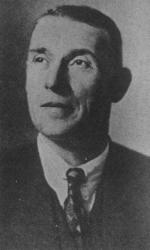
Valeryan Podmogilnuy
 Ukraine
Biography of Valerian Podmogilny
Valerian Podmogilny was a Ukrainian writer and translator. He was born in a peasant family in the village of Chapli in the Yekaterinoslav Governorate. His father, Pyotr Podmogilny, worked as a clerk in the village of Pisarevka, Pavlograd District. His mother was an illiterate peasant. Valerian's parents dreamed of giving their children an education and hired a French language teacher for their eldest daughter. This was Valerian's first encounter with a foreign language.
Education and Early Career
Valerian initially attended a church parish school. In 1910, he enrolled in the 1st Yekaterinoslav Real School, where the emphasis was on exact sciences. He excelled in his studies and became proficient in Russian, German, and French. When the university opened in Yekaterinoslav, he became a student at the Faculty of Mathematics. However, the civil war, famine, and financial difficulties forced Podmogilny to leave his studies.
Literary Work and Persecution
In 1919-1920, Podmogilny worked in the Department of Public Education as the secretary of the Department of Art Propaganda. He also taught mathematics at the Ivan Franko School and worked as a teacher in Pavlograd, where his parents lived. During this time, he published nine of his stories, including "Starets," "Complicated Question," "Vanya," "Haydamak," "Good God," "In the Village," "On Name Day," and "Grandfather Yakim."
Podmogilny translated works by Voltaire, Balzac, Diderot, and Maupassant from French into Ukrainian. His notable literary achievements include the novels "Misto" (The City, 1928) and "Nevelyka Drama" (A Small Drama, 1930). After Ukraine gained independence, the novel "The City" was included in the school curriculum for Ukrainian literature. A Russian translation of the novel was published in Moscow in 1930.
In 1923, Podmogilny joined the literary association Apsis. In the 1920s and 1930s, he was a member of the literary association "Workshop of Revolutionary Word," which led to persecution by the Soviet authorities. The writer was sentenced to death and executed in Solovki. His last work, "Povist bez nazvy" (Untitled Story, 1934), remained unfinished and without a title. The manuscript was kept under a ban in a special archive for nearly fifty years.
Valerian Podmogilny, in his works, was one of the first to feel the absurdity of human existence and the vulnerability of individuals against the power of government.