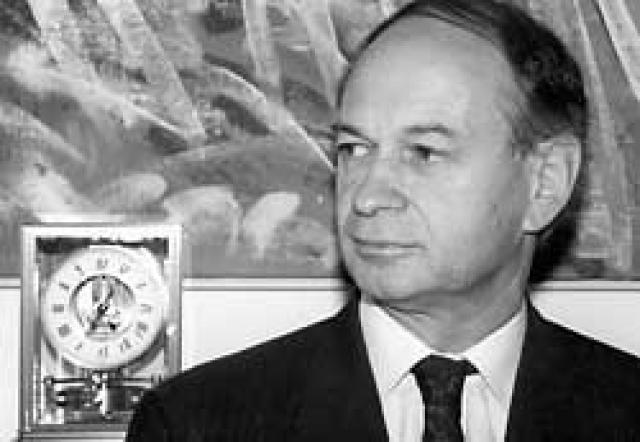
Valter Fecherin
 Switzerland
- Biography of Walter Fecherin
- The Challenging Role of an Ambassador
- Maintaining Composure in Stressful Situations
- Adapting to Different Environments
- Dealing with Stress and Maintaining Well-being
- The Public vs. Private Life of an Ambassador
- An Ambassador's Social Responsibilities
- The Swiss Healthcare System
Biography of Walter Fecherin
Walter Fecherin is the Extraordinary and Plenipotentiary Ambassador of Switzerland to the Russian Federation. He studied at the University of Zurich and the University of Vienna, and also graduated from the Max Planck Institute and the doctoral program at the University of Zurich. Prior to his current appointment, he worked in Poland, the Soviet Union, Canada, the Republic of Korea, and the Czech Republic, holding various responsible positions in the Swiss Ministry of Foreign Affairs. In addition to German, French, Italian, and English, he also speaks Russian fluently. He is married and has two sons and a daughter. He is passionate about Taekwondo.
The Challenging Role of an Ambassador
When asked about the difficulty of being an ambassador compared to other professions, Walter Fecherin described it as a varied and sometimes challenging job. However, he finds it incredibly interesting and enjoyable. He acknowledges that being an ambassador can be stressful due to interactions with the press and high-ranking officials. Every word he utters carries the weight of being the official standpoint of the state he represents. The profession of an ambassador encompasses almost every aspect of international life. Despite the stress and anxieties, there are many positive aspects, especially the opportunity to interact with fascinating individuals.
Maintaining Composure in Stressful Situations
When asked what could anger him at work to the point of serious frustration, Walter Fecherin mentioned the lack of timely responses or reactions to important questions. He admitted to being generally composed, and it takes a great deal of effort to provoke him. He believes that expressing anger openly and frequently is a sign of weakness, especially when directed towards subordinates. He attributes his calm demeanor to his character rather than his Swiss nationality, although he acknowledges that the Swiss culture emphasizes compromise, which may contribute to his ability to remain level-headed.
Adapting to Different Environments
When Walter Fecherin first arrived in Moscow, he did notice a significant difference in the ecological state compared to Switzerland, which is known for its clean environment. However, he mentioned that Switzerland's environmental situation has greatly improved over the years. He had previously lived in Seoul, South Korea, which had even worse ecological conditions. Therefore, adapting to Russia's environment was not particularly difficult for him, as he had already become accustomed to different living conditions through his experiences abroad.
Dealing with Stress and Maintaining Well-being
Walter Fecherin shared that he enjoys being physically active to cope with stress. He enjoys going for walks and engaging in sports. He is a member of a club where he exercises on training equipment and practices Taekwondo. He finds the process of memorizing different movements and their reproduction during training to be particularly interesting. Although he used to participate in full-contact Taekwondo in the past, he now prefers non-contact forms of the sport. He also enjoys skiing and horseback riding, like many of his compatriots.
The Public vs. Private Life of an Ambassador
Walter Fecherin explained that the public image of an ambassador, with the car and the official functions, is quite different from the actual work that takes place in the embassy. A significant part of an ambassador's duties occurs behind closed doors in their office. The public often assumes that being an ambassador is simply about enjoying life in a foreign country. While he does derive immense pleasure from interacting with various individuals, receptions and social events are crucial for establishing and maintaining contacts. However, these events represent only a fraction of the ambassador's overall work.
An Ambassador's Social Responsibilities
When asked if being an ambassador involves a lot of drinking, Walter Fecherin explained that the time when ambassadors had to drink excessively is long gone. While he may occasionally drink wine during toasts or when etiquette requires, it is not necessary to drink excessively. He personally consumes very little alcohol, although the increasing social demands of his role have led to more toast-worthy occasions. He emphasized that responsible drinking is essential to maintain professionalism.
The Swiss Healthcare System
Regarding the Swiss healthcare system, Walter Fecherin described it as a combination of private and mandatory health insurance. Every citizen is required to have health insurance, and while it is private, it provides clear guarantees and extensive coverage for any health issues. The level of coverage can be adjusted based on personal preferences, with more services available at higher costs. He highlighted that Switzerland has the highest number of insured individuals globally, which he attributed to the Swiss population's cautious nature and awareness of potential health risks.