Valter Ratenau
 Germany
- Biography of Walter Rathenau
- Early Life and Career
- Intellectual Pursuits
- Political Career
- Jewish Identity and Assassination
- Postscript
- Legacy
Biography of Walter Rathenau
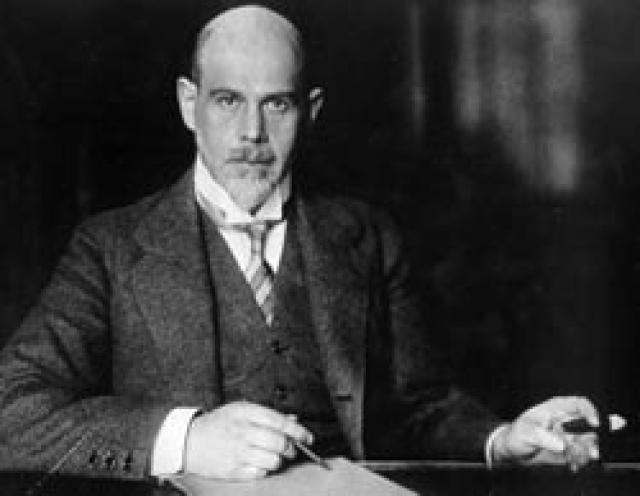
IntroductionWalter Rathenau (1867-1922) was a prominent German industrialist, politician, and thinker. He served as the Minister of Foreign Affairs for Germany in 1922 and was always mindful of his Jewish identity.
Early Life and Career
Walter Rathenau was born in Berlin, Germany, in a renowned family. His father, Emil, was a well-known engineer and entrepreneur. Rathenau, who had a background in electrical engineering, became a member of the board of directors of AEG, a leading company in the field, in 1899. He later became its president in 1915. Additionally, he owned a trading company in Berlin from 1902 to 1907 and served on the board of more than 100 other companies. Rathenau was one of the most distinguished technical experts in Germany and was highly regarded in the field.
Intellectual Pursuits
In addition to his work in the technical field, Rathenau devoted himself to literature, science, and journalism. His articles, books, and scientific publications gained a wide readership. He left a remarkable legacy in German and global history, particularly through his family, including his own contributions.
Political Career
With the outbreak of World War I, Rathenau became the head of the Department of Raw Materials in the Prussian War Ministry. He quickly emerged as one of Germany's key political figures, making responsible decisions both domestically and internationally. In 1919, Rathenau participated as an expert in the peace conference, and in 1920, he became a member of the Commission for Nationalization. In 1921, he led the Ministry of Economic Reconstruction. As the Minister of Foreign Affairs from February 1, 1922, Rathenau played a significant role in the famous Genoa Conference, where he concluded the Treaty of Rapallo with Russia.
Jewish Identity and Assassination
Throughout his life, Rathenau never forgot his Jewish heritage. He acknowledged the discrimination faced by German Jews and wrote about the painful realization of being treated as second-class citizens. In an article from 1897 titled "Listen, Israel!", Rathenau warned against Jews standing out, although he himself was a prominent Jewish figure. He rejected conversion as a means to escape discrimination, stating that it would only appease the ruling class's lawlessness. He criticized Prussian policies towards Jews as a grave insult to the entire population. Rathenau believed in the freedom of spirit and soul, disregarding any hierarchical distinctions based on blood.
Sadly, the defeat in the war, inflation, unemployment, and poverty fueled anti-Semitic sentiments. In 1922, Rathenau faced threats and was killed by three officers from the right-wing extremist organization "Consul". His personal tragedy served as a prologue to the Catastrophe.
Postscript
Werner Technow, one of Rathenau's assassins, managed to evade capture. Technow's mother received a letter from Rathenau's mother, an exceptional woman, in which she extended her hand to the poorest of all women. She expressed her forgiveness for Technow if he fully acknowledged his guilt before an earthly court and repented before God. Rathenau's mother believed that if Technow had known her son, a noble man, he would have turned his weapon against himself rather than harming him. This letter had a profound impact on Technow, who later joined the Foreign Legion and became a key figure in saving persecuted Jews in France. It is reported that he assisted over 700 refugees. Technow attributed his transformation to this letter, stating that it opened up a new world for him.
Legacy
Numerous books have been written about Walter Rathenau, highlighting his multifaceted and complex nature. His life and contributions continue to be the subject of debate among researchers.