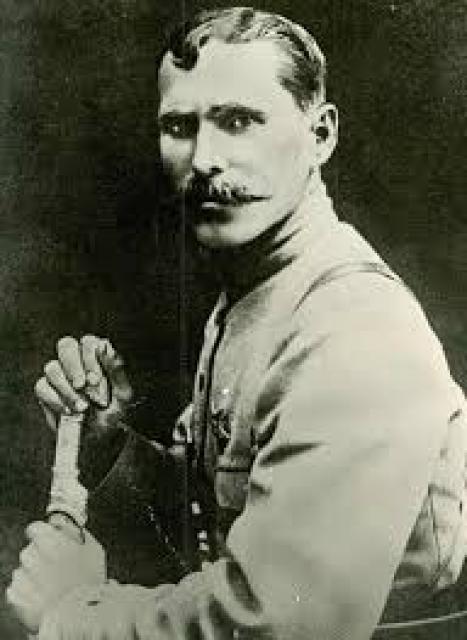
Vasiliy Chapaev
 Russia
- Vasili Chapaev: A Mystery Unraveled
- The Battle of Lbischensk and the Controversy
- Betrayal and Personal Turmoil
- Post-Battle Fate
- The Myth and the Legacy
- Was Chapaev a Military Genius?
- The Legacy of Mystery
Vasili Chapaev: A Mystery Unraveled
Early Life and Military ServiceVasili Ivanovich Chapaev was born in 1887 in the Volga region of Russia. He joined the Imperial Russian Army in 1914 and fought with distinction in World War I, earning the coveted Cross of St. George for his bravery.
After the Bolshevik Revolution in 1917, Chapaev joined the Red Army and quickly rose through the ranks. In 1918, he became commander of the legendary 25th Rifle Division, known for its daring partisan tactics and repeated victories against the White Army.
The Battle of Lbischensk and the Controversy
In September 1919, Chapaev's division was defeated at Lbischensk, leading to the commander's reported death. However, the circumstances of his demise have been shrouded in mystery and speculation.
Some accounts claim that Chapaev was killed by a White Cossack bullet while swimming across the Ural River. Others suggest that he escaped the battle and went into hiding.
There are inconsistencies in the official account, including the claim that Chapaev's body was never found. Furthermore, witnesses described a figure resembling the commander swimming across the river, only to vanish into the undergrowth.
Betrayal and Personal Turmoil
Recent research has revealed that Chapaev's defeat at Lbischensk may have been due to treachery. His personal life was also tumultuous, with accusations of infidelity and betrayal from his wife and his mistress.
Post-Battle Fate
Despite the official narrative of Chapaev's death, rumors persisted that he survived and went into hiding. Some claimed he joined the Mongolian Red Army, while others believed he lived under an assumed name in the Soviet Union.
In 1941, a veteran claimed to have met Chapaev in disguise. In 1998, another witness recounted meeting a blind man who bore a striking resemblance to the commander and who claimed to be the real Chapaev.
The Myth and the Legacy
Chapaev's death became the subject of intense speculation and became the inspiration for numerous jokes and legends. However, the historical truth remains uncertain.
Regardless of the facts, Chapaev became a legendary figure in Soviet folklore and propaganda. His heroic image was extensively promoted, and his name was synonymous with bravery and sacrifice.
Was Chapaev a Military Genius?
While Chapaev was a skilled commander, it is questionable whether he was truly a military genius. His tactics were often based on sheer audacity and improvisation, and he lacked the strategic vision of some of his contemporaries.
However, in the chaos and turmoil of the Russian Civil War, Chapaev's daring and charisma filled a void. He became a symbol of hope for the Red Army and a legend for generations to come.
The Legacy of Mystery
The mystery surrounding Chapaev's death adds to his enigmatic appeal. His fate remains uncertain, and the possibility that he escaped the battle and lived a secret life fuels the imagination of historians and enthusiasts alike.
Chapaev's legacy is a testament to the power of myth and the enduring appeal of a figure caught between fact and fiction.





