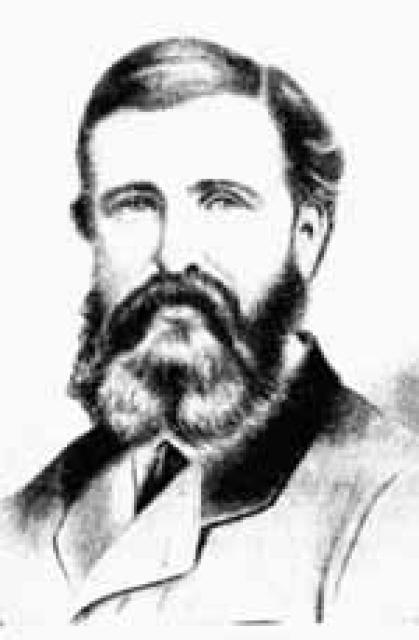
Verni Kameron
 Great Britain
- Early Life and Career
- Expedition to Central Africa
- Discovery of Lake Tanganyika's Outlet
- Journey Across Africa
- Scientific Contributions
- Theoretical Insights
- Legacy
Early Life and Career
Verney Lovett Cameron was born in 1844 in England. He joined the Royal Navy and rose to the rank of lieutenant. Cameron was a polyglot who spoke several languages, including Arabic and Swahili.
Expedition to Central Africa
In 1872, Cameron embarked on an expedition to Eastern Africa in search of the missing explorer David Livingstone. In February 1873, he landed on the mainland at Bagamoyo and set out westward with a small party, including Bidali Wadi Asman, a guide who had worked with both Livingstone and Henry Morton Stanley.
Discovery of Lake Tanganyika's Outlet
In October 1873, Cameron's expedition encountered a caravan carrying Livingstone's body to Zanzibar. Cameron decided to continue westward and, in February 1874, reached Lake Tanganyika at Ujiji. He circumnavigated the lake's southern shore and discovered the Lukuga River flowing out of it on May 3, 1874. The discovery of the lake's outlet, which had been a subject of much speculation, was a significant geographical achievement.
Journey Across Africa
After exploring the southern shores of Lake Tanganyika, Cameron mapped the sources of several rivers, including the Lomami, Lwembe, Lubilash, and Lulwa. He reached Bie in October 1876 and, after a difficult journey through a famine-stricken region, completed his trans-African crossing at Katumbela in November 1875.
Scientific Contributions
Cameron's expedition provided important scientific contributions. He conducted a detailed route survey, made hundreds of astronomical observations, and measured the altitude of over 3,700 points. These measurements provided the basis for the first hypsometric map of Central Africa.
Cameron's expedition also clarified the hydrography of the Lualaba River. He identified the Lufira River as a tributary of the Lualaba, corrected Livingston's misconception of the Western Lualaba, and established that the Lualaba was the upper course of the Congo River.
Theoretical Insights
Beyond his field research, Cameron made important theoretical contributions to the geography of Central Africa. He proposed the hypothesis that the Congo Basin extended on both sides of the equator, a concept that was later confirmed. He also suggested that the Uele River discovered by Georg Schweinfurth might be a tributary of the Congo.
Legacy
Cameron's trans-African journey was the first historically proven crossing of the continent from east to west. His expedition provided valuable scientific data and contributed to the understanding of Central Africa's geography and hydrology. Cameron died in Africa in 1894, leaving behind a legacy of exploration and scientific discovery.