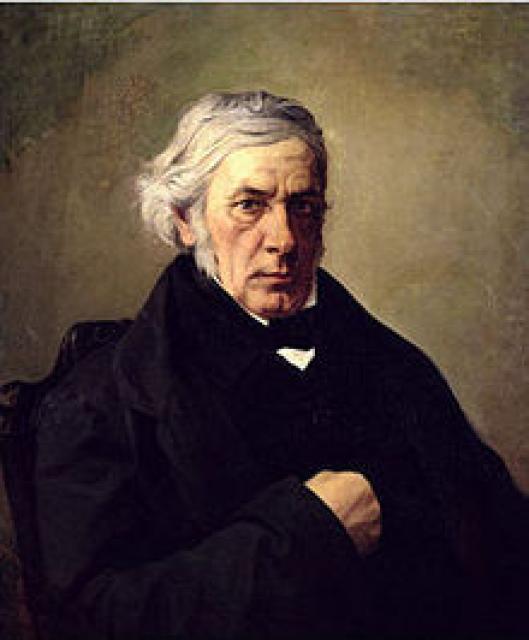
Victor Cousin
 France
Biography of Victor Cousin
Victor Cousin was a French philosopher, educationalist, and historian, born on November 28, 1792, in Paris, France. He came from a working-class family and had the opportunity to receive his education at the Lycée Charlemagne and later at the Higher Pedagogical Institute. In 1815, he began his teaching career at the Higher Pedagogical Institute, delivering lectures on the philosophy of common sense. Cousin was influenced by the ideas of Immanuel Kant and traveled to Germany, where he met prominent philosophers such as Georg Wilhelm Friedrich Hegel, Friedrich Schelling, and Friedrich Heinrich Jacobi.
Career and Contributions
Cousin's defense of constitutional government led to his dismissal in 1820. However, he was reinstated in 1828 and enjoyed strong support from the government after Louis-Philippe ascended to the throne in 1830. He became a peer of France, a member of the State Council, a member of the French Academy, and in 1834, the rector of the Higher Pedagogical Institute. Cousin developed a philosophical system which he named eclecticism, although critics referred to it as spiritualism. He divided philosophy into four types of systems: sensationalism, idealism, skepticism, and mysticism, seeing elements of truth in each.
Cousin was known for his moderation and willingness to compromise, which earned him wide public recognition. His rare talent as an orator made him popular among several generations of students. In 1840, when François Guizot became the prime minister, Cousin was appointed Minister of Education. Despite the wishes of the Catholics, he maintained the teaching of philosophy in secondary schools but required teachers to adhere to his views on which philosophy to teach. Cousin resigned in 1848. He made significant contributions to the field of history of philosophy, making it a popular subject. He published works on Proclus, Peter Abelard, René Descartes, and Maine de Biran, as well as translations of Plato.
Philosophical Contributions
In contrast to skepticism prevalent in the 18th century, Cousin adhered to a psychological approach influenced by the work of François Maine de Biran in France and Thomas Reid in Scotland. In his later period, under the influence of Friedrich Schelling, Cousin added ideas of a romantic-cosmological nature to this approach. He believed that philosophy should always begin with an analysis of consciousness, which reveals three fundamental types of facts: sensations, which provide our first acquaintance with the external world; our own activity, which reveals the fact of human freedom; and reason, which allows us to grasp certain fundamental and objectively significant principles.
The two main principles of reason are substance and causality. Through them, we understand how the self and the world (the self and the non-self, in Fichte's terminology) are connected in the ultimate substance, God, whose creative causality gives the universe a rational structure. Thus, Cousin's psychology culminates in ontology and sanctions moral and aesthetic principles.
Works and Legacy
Among Cousin's notable works are "Philosophie sensualiste au 18e siecle" (1819), prefaces to "Fragments philosophiques" (1826) and "Nouveaux fragments philosophiques" (1828), "De la métaphysique d'Aristote" (1835), "Du vrai, du beau et du bien" (1836), "Cours d'histoire de la philosophie moderne" (1841-1846), "Etudes sur Pascal" (1842), and a series of studies on exceptional women of the 17th century. Victor Cousin passed away on January 13, 1867, in Cannes, France. His contributions to philosophy and education continue to be influential and highly regarded.