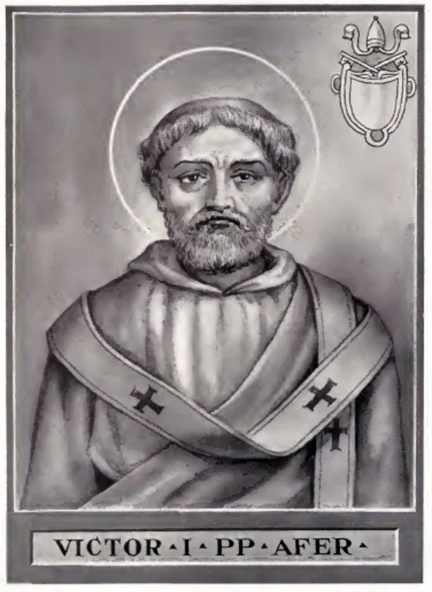
Victor I
Victor I was bishop of Rome near the end of the second century, a period when Christian communities across the Mediterranean were still developing shared practices and structures. He is best known for a heated dispute over when Easter should be celebrated. The episode reveals both the growing reach of Rome’s bishop and the diversity that remained among early Christian churches.
A bishop in second-century Rome
Victor led the Christian community in Rome from about 189 until around 199, although ancient sources differ on the exact dates. Little is known about his early life. A later account says he came from Africa, but his birthplace and family background cannot be established with confidence.
During his leadership, Christianity continued to spread across the Roman Empire. The church in Rome communicated with communities in regions including Gaul, Asia Minor, Palestine, and Egypt. Victor’s correspondence and efforts to convene meetings show that the Roman bishop was increasingly involved in questions affecting churches far beyond the city.
The Easter controversy
The major controversy of Victor’s pontificate concerned the date of Easter, or Pascha. Many Christians in Rome and elsewhere marked the festival on a Sunday. In Asia Minor, some communities followed the Quartodeciman custom, observing it on the fourteenth day of the Jewish month of Nisan, regardless of the day of the week.
Victor pressed for a common Sunday observance. Bishops and church gatherings across different regions considered the question, but Polycrates of Ephesus defended the Asian practice, citing the tradition of earlier Christian leaders in the region. Victor responded by attempting to exclude the churches of Asia Minor from communion.
Irenaeus, bishop of Lyons, urged Victor not to break fellowship over the disagreement. He noted that Christians had followed differing customs in earlier generations while remaining in communion. Victor’s stance was forceful, but Irenaeus’s intervention helped prevent a lasting rupture.
A growing Roman authority
The dispute is one of the earliest recorded examples of a bishop of Rome trying to direct church practice beyond his own community. Later Christians would see the episode as part of the history of papal authority, though the account also shows that other bishops could challenge Rome and that regional traditions held real weight.
Victor is also associated in ancient accounts with confronting Christian teachers whose views he considered heretical. Few writings from his own hand survive, so much of what is known about him comes through later historians, especially Eusebius, who preserved material about the Easter debate.
Legacy
Victor’s pontificate is remembered less through personal details than through the conflict that defined it. The Easter controversy brought questions of unity, tradition, and authority into sharp focus. The compromise between a shared church calendar and regional practice would take centuries to settle, but Victor’s dispute remains a revealing glimpse of Christianity as it organized itself across the Roman world.