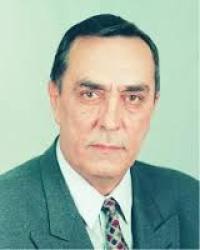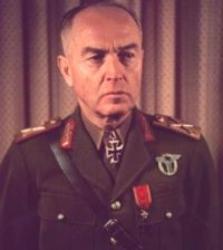
Viktor Sokolov
 Russia
- Prominent Anti-Semitic Leader
- Involvement in the URP
- Leadership and Oratory
- Split within the URP and Subsequent Chair of the Grand Council
- Anti-Semitism and Publications
- Defense of the URP against Accusations
- Post-URP Activities
- Continued Support for Monarchism
- Involvement in Monarchist Meetings and Publications
Prominent Anti-Semitic Leader
Early Life and CareerVasily Petrovich Sokolov was a renowned public figure and a founder and then deputy chairman of the Grand Council of the Union of Russian People (URP). He was born into a noble family as the son of General P.V. Sokolov, who had also been a founder of the URP. Sokolov suffered from a physical disability, which earned him the nickname "Sokolov-Gorbaty" (Sokolov the Hunchback). He pursued an engineering degree but did not complete his studies.
Involvement in the URP
In October 1905, Sokolov became an active member of the "Union for the Revival of Russia," an organization comprising professors and students from universities in St. Petersburg who supported the Slavophile ideology. When this organization focused primarily on theoretical discussions and avoided practical action, Sokolov joined the URP, which was being established around the end of 1905. As a founding member, he played a critical role in organizing combat squads to counter revolutionary terrorism alongside A.I. Dubrovin, A.A. Maikov, Count E.I. Konovalov, and N.M. Yushkevich-Kraskovsky. Members of these squads swore allegiance and vowed not to betray one another.
Leadership and Oratory
Sokolov emerged as one of the most active campaigners for the URP. As a member of the Grand Council, he participated in the Yaroslavl Conference in March 1909, where he addressed the issue of the hostile attitude towards the URP by local administrators. He advocated for a circular urging administrative support for the activities of right-wing organizations.
Sokolov also served as the secretary of the conference's organizational committee. During the discussion of the editorial commission's report, he proposed an amendment alongside Prince M.N. Volkonsky, emphasizing that the "harm inflicted by Jewry on the Russian people and Russian statehood was so pronounced that the rights of Jews should not be expanded in any way but should be restricted by special laws, and that the strictest oversight should be maintained over the enforcement of restrictive laws on Jews."
Split within the URP and Subsequent Chair of the Grand Council
Following the departure of V.M. Purishkevich and A.I. Trishchenko from the URP, Sokolov became the deputy chairman of the Grand Council, serving as the closest aide to A.I. Dubrovin. However, during the URP's schism in 1910, Sokolov sided with N.E.Markov and remained the deputy chairman of the "Markovan" URP until the February Revolution. He played a prominent role, effectively becoming the most active member of the "Markovan" Grand Council, but did not gain widespread popularity among the right wing.
Anti-Semitism and Publications
Sokolov became the editor of the "Vestnik Soyuza Russkogo Naroda" from issue 171 in January 1914 until its final issue, number 217, on September 20, 1915. He engaged in heated debates with supporters of A.I. Dubrovin and defended the actions of the "renewalists." On February 19, 1911, at a ceremonial meeting of the URP commemorating the abolition of serfdom, Sokolov delivered a speech on the origins and history of serfdom in Russia. He emphasized that not only peasants but all social classes had long been serfs to the state because the interests of the Fatherland demanded it. Peasants were only different in that they received freedom later than others. In conclusion, he urged vigilance against the danger of the entire Russian people being re-enslaved, this time with "Jews as the master." He warned against selling land to Jews, stating, "The Russian people have been freed from one form of serfdom, but now we are faced with the prospect of an even worse fate if we do not fight against the economic dominance of Jews! Beware of the monetary dependency on Jews! Beware of selling land to them. Protect your land!"
Defense of the URP against Accusations
On April 29, 1911, Sokolov addressed a meeting of the URP, refuting allegations made by the left-wing press against the Union regarding Jewish pogroms. He argued that "the left-wing press, while accusing the Union of organizing Jewish pogroms, consciously ignores the fact that the main wave of pogroms occurred during a time when the Union did not exist. The most recent pogrom in Bialystok took place when there was no branch of the Union there." Sokolov further countered accusations of political assassinations by the URP, emphasizing that the Union had responded to the murders of their comrades by revolutionaries with memorial services and that they had walked in religious processions despite being met with bombs and bullets.
Post-URP Activities
Besides his active involvement in the URP, Sokolov was also an active member of the Russian Assembly (PC) from 1911. On January 23, 1912, he was elected chairman of the Organizing Council for the All-Russian Congresses. He played a significant role in preparing and holding the Congress of Supporters of Markov (the 4th All-Russian Congress of the URP) from May 14-16, 1912, and the 5th All-Russian Congress of Russian People from May 16-20, 1912. At both Congresses, he was elected deputy chairman of the organizing section and delivered a report on behalf of the Grand Council. The 5th Congress, convened on the initiative of the URP, tasked the Grand Council with developing a plan for unifying patriotic monarchist organizations. The Grand Council, in turn, delegated this task to S.A. Vladimirov. However, Sokolov independently prepared his own unification proposal, which differed significantly from Vladimirov's and suggested a mandatory merger of all monarchist organizations. Sokolov proposed establishing a unified Council of Councils based on the governing bodies of patriotic Unions, whose decisions would become binding for all organizations. These two proposals were widely discussed by monarchist organizations throughout the summer and autumn of 1912, but the issue of unification remained unresolved.
Continued Support for Monarchism
In October 1913, Sokolov, on behalf of the Grand Council, sent a telegram of support to G.G. Zamyslovsky and A.S. Shmakov for their "valiant speeches in defense of innocent Christian youths who were being brutally murdered by Jewish fanatics." In October 1915, the Grand Council of the URP issued a Circular Letter signed by Chairman N.E. Markov, Deputy Chairman Sokolov, and Secretary R.V. Tregubov, addressing the political situation in the country. It denounced "the internal enemies of our homeland: constitutionalists, parliamentarians, revolutionaries, and especially the Germans and Jews, who are striving in every way to deceive the Russian people." It further warned that, under the guise of patriotism, they aimed to undermine the rights of the Tsar-Autocrat. "The Jewish Freemasons have raised such an outcry that the government, not hearing the voice of the true Russian people, not seeing the moral support of the Russian people, has begun to falter and may yield to the brazen desires of the enemies," the letter stated. The URP leaders called upon all monarchists to make their voices heard by sending telegrams and letters of support to the Emperor and the Chairman of the Council of Ministers. "Let the government know that 'the true Russian people will not allow the Autocrat of All Russia to be diminished, the only defender of the people from the dominance of Germans, Jews, and foreigners, will not allow Russia to be governed by hired servants, Jewish Freemasons," the letter concluded.
Involvement in Monarchist Meetings and Publications
Sokolov actively participated in the preparation and proceedings of the Petrograd Conference (the Meeting of Monarchists from November 21-23, 1915, in Petrograd). He authored a draft resolution on combating German dominance. At the Conference, he was elected to the Council of the Conference, which later transformed into the Council of Monarchist Congresses. Sokolov also served as the editor of the Conference's collection of resolutions and protocols. Between 1915 and 1916, Sokolov was a member of an informal circle of right-wing statesmen who gathered at the home of Senator A.A. Rimsky-Korsakov.
Attempts to Unify Monarchist Factions and Resistance after the February Revolution
From late 1915, there was a gradual rapprochement between representatives of the two opposing factions within the URP. By the beginning of December 1916, Sokolov and A.I. Dubrovin had approached I.G. Shcheglovitov to clarify the reasons for the prohibition of the Monarchist Congress in Moscow. In early 1917, Sokolov was one of the organizers of an ultimately unsuccessful right-wing congress in Petrograd. After failing to obtain permission to hold the Congress, the Chairman of the Grand Council of the URP, N.E. Markov, Deputy Chairman Count V.F. Heiden, Sokolov, and the Secretary, R.V. Tregubov, issued a circular letter to local organizations urging them to hold meetings and elect delegates to prepare for an upcoming Congress. They explained their position, stating, "We dare not remain silent, for then we might be counted among those who, like Purishkevich, dared to repeat the vile slander invented by the Jewish Freemasons in order to gain popularity and applause from Jewish