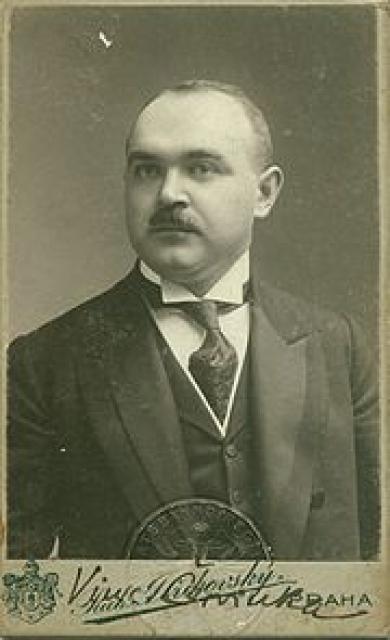
Vincenc Chervinka
 Czech
Czech- Early Life and Education
- Journalism and Activism
- Literary Pursuits
- Imprisonment and Revolution
- Post-War Years
- Traveling and Publishing
- Honors and Remembrance
Early Life and Education
Born in the heart of Bohemia, Jaroslav Červinka embarked on a journey of intellectual enlightenment that would shape his future. He delved into the intricacies of medicine at Charles University in Prague before pursuing philology in the illustrious halls of Berlin and St. Petersburg.
Journalism and Activism
Upon returning to his homeland, Červinka's path intertwined with that of Alois Rašín. Together, they steered the weekly "Slovo" as its editor-in-chief from 1901 to 1905. His journalistic endeavors continued in St. Petersburg, where he served as a correspondent for "Národní listy." Later, he joined forces with Karel Kramář to establish the influential magazine "Nová česká politika."
Literary Pursuits
Červinka's literary prowess extended beyond journalism. As a translator, he brought the works of eminent Russian authors to Czech audiences, including Ivan Bunin, Leonid Andreyev, and Arkady Averchenko. His translations also included the plays of Jewish playwright Leo Birinski.
Imprisonment and Revolution
Červinka's commitment to Czech independence cost him dearly. In 1916, he was sentenced to death along with Rašín and Kramář for their involvement in the Czech movement. However, the sentence was commuted to 20 years of hard labor. With the collapse of the Austro-Hungarian Empire, he and his fellow prisoners were finally released.
Post-War Years
In the newly independent Czechoslovakia, Červinka resumed his journalistic career at "Národní listy," where he remained until 1934. He also served as the first chairman of the Trade Union of Czechoslovak Daily Press. His 1928 memoir, "My Austrian Imprisonment," chronicled the harrowing events of his wartime incarceration.
Traveling and Publishing
Červinka embarked on a remarkable voyage around the globe from 1919 to 1920, delivering lectures in the United States before venturing to the Far East and Siberia to meet with Czech legionnaires. He returned to Europe via China, India, and the Suez Canal. As the curator of the "Russian Library" series at Otto Publishing, Červinka introduced the works of renowned Russian writers such as Valery Bryusov, Mikhail Bulgakov, and Ivan Nazhivin to Czech readers, further cementing his legacy as a literary bridge between nations.
Honors and Remembrance
Červinka's contributions to journalism, literature, and Czech independence earned him the prestigious Lithuanian Order of Gediminas, Third Degree, in 1928. His name remains etched in the annals of Czech history as a tireless advocate for freedom and a fervent proponent of cultural exchange.