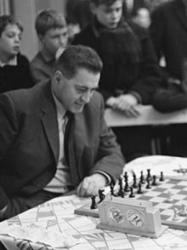
Vincent Grimm
 Hungary
Vincent Grimm was a Hungarian chess master whose life linked the cafés of nineteenth-century Pest with the political upheaval of the 1848–49 Hungarian Revolution. A skilled lithographer and printmaker as well as a leading player, he helped build the city’s early chess community, contributed to a celebrated correspondence victory over Paris, and spent nearly two decades in exile before returning to Hungary.
From Vienna to Pest
Grimm was born in Vienna on March 15, 1801. He moved to Pest as a young man and worked in several fields, including education, art and the book trade. He became known as a gifted draftsman and lithographer, and established a shop selling art and music materials. He later set up a printing business, bringing him into contact with the cultural and political life of the reform era.
Chess became another important part of his public life. Alongside József Szén and János Jakab Löwenthal, Grimm was among the strongest Hungarian players of his generation. The three helped establish the Pest Chess Club around 1839, one of the earliest organized chess societies in the country. In a period when cafés and reading rooms served as lively meeting places, the club gave local players a base from which to test themselves against the broader European chess world.
The Pest–Paris match
Grimm’s place in chess history is closely tied to the correspondence match between Pest and Paris, played from 1842 to 1845. Paris had a formidable reputation, and the challenge attracted attention well beyond Hungary. Grimm, Szén and Löwenthal were central to the Pest team, which won the contest. Their success helped establish Hungarian chess as a serious force in international play.
Grimm also played over-the-board games, composed chess problems and contributed to chess writing. His reputation spread among visiting players, and he continued to follow the game even when political events carried him far from Pest. In 1851, while living in exile, he received an invitation to the major international tournament held in London alongside the Great Exhibition. He declined, missing a chance to join several of Europe’s leading players in a landmark event.
Revolution, exile and return
Grimm’s work as a printer drew him into Hungary’s struggle for independence. During the 1848–49 revolution, he became involved in producing banknotes for the revolutionary government led by Lajos Kossuth. The uprising’s defeat made him a target of the authorities, and he had to leave the country. He was among those present when the Hungarian crown was hidden near Orșova as the revolution collapsed.
His flight led him into the Ottoman Empire. There he worked in a cartographic institution and served with an officer’s rank, reportedly using the name Murad Bey. He continued to play chess and to write about it, keeping his ties to European chess alive from afar. The upheaval that had displaced him also kept him from returning home for many years.
Grimm was finally able to return to Pest in 1868. He resumed his connection with the chess community and was honored by the club he had helped build. He died in Pest on January 15, 1872.
A legacy across two worlds
Grimm’s story is more than a record of tournament play. He belonged to the generation that organized Hungarian chess into a recognizable community, and the Pest team’s victory over Paris became an early source of national pride in the game. At the same time, his career as a lithographer and printer placed him in the political currents that transformed Hungary—and ultimately forced him into exile.
The two strands of his life remained intertwined: the chess master who helped represent Pest across Europe, and the craftsman whose work connected him to the revolutionary cause. His return after years abroad allowed him to see the chess circle he had helped establish continue, leaving him remembered as both a cultural figure and one of Hungary’s pioneering masters.