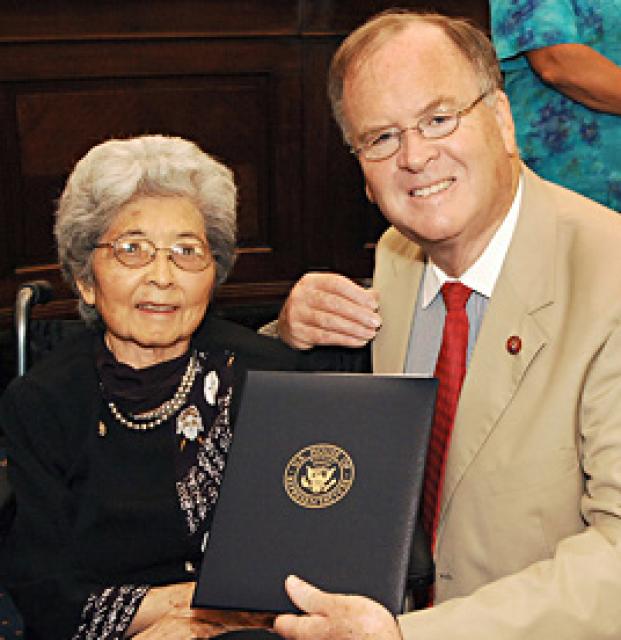
Violet Kazue De Cristoforo
 Japan
JapanViolet Katsué de Cristoforo: A Life of Resilience and Advocacy
Violet Katsué de Cristoforo, born Kazue Yamane, was a Japanese-American poet and haiku composer. She was born on September 3, 1917, in Ninole, Hawaii. She grew up in Fresno, California, and the Japanese city of Hiroshima.

After completing her education in the United States, Katsué married Shigeru Matsuda and they had two young children. When her family was forcibly sent to an American internment camp near Fresno, Katsué was pregnant with her third child. She gave birth to her baby on an improvised table made from orange crates. Katsué and Shigeru were separated, ending up in different internment centers.
Throughout the remainder of World War II, Katsué and her children were moved between the Jerome camp in Arkansas and the Tule Lake camp in California. They were finally liberated at the end of the war. The experience of being interned left a lasting impact on Katsué's work, with many of her original haiku being lost or destroyed. However, her later works and preserved letters vividly reflect the devastation and despair she felt during that time.
In 1946, Katsué and her children were deported to Japan. It was later revealed that her husband had returned to Japan and remarried. In Japan, Katsué witnessed firsthand the destruction caused by the American atomic bombs and its effects on Japanese citizens.
It was in Japan that Katsué met her second husband, Wilfred H. de Cristoforo, a United States Army officer. She immigrated with him to the United States and settled in Monterey, California. In addition to her writing, Katsué worked for 'The McGraw-Hill Companies' media conglomerate. Her marriage lasted until Wilfred's death in 1998.
A few weeks before her own passing, Katsué received the highest honor from the National Endowment for the Arts in Washington, D.C., the 'National Heritage Fellowship,' for her cultural achievements through her writing. She died on October 3, 2007, at the age of 90, due to complications from a stroke. She left behind two daughters, a son, and two grandchildren.
Katsué became a prominent advocate for Japanese-Americans who had endured the horrors of internment camps. Her work, along with the efforts of other activists, ultimately led to the United States government providing compensation and issuing official apologies to the 120,000 Japanese-Americans who suffered during World War II.


