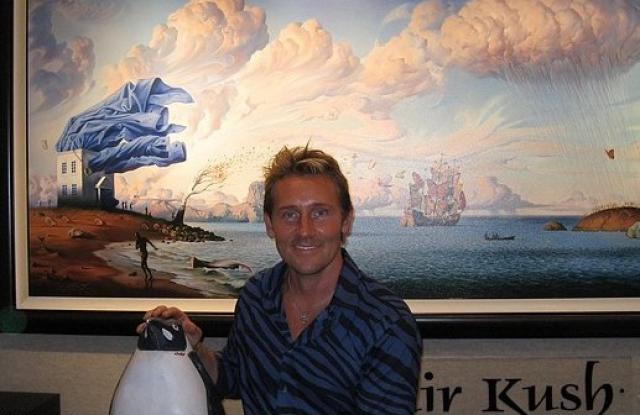
Vladimir Cush
 Sudan
Sudan- Biography of Vladimir Kush
- Influence of Soviet Union
- Emigration to America
- Struggles and Success
- Success in Hong Kong
Biography of Vladimir Kush
Early Life and EducationVladimir Kush is an American artist of Russian origin. He was born in Moscow and grew up surrounded by a family of artists. His love for painting began at the age of 7 when he enrolled in an art school in the Krasnopresnensky district. He spent 10 years studying at this school before moving on to the Stroganov Academy. After completing his studies at the academy, Kush decided to immigrate to America.
Influence of Soviet Union
Kush's decision to leave the Soviet Union was influenced by the significant changes taking place in the country. He witnessed the perestroika and the resulting cultural shift in the art scene. The avant-garde artists of the time, particularly the legendary art group 'Dvadtsat' (Twenty), greatly interested him. In 1987, Kush started earning a living as an artist by working on Arbat Street in Moscow. He initially painted portraits for passersby, but soon his talent attracted the attention of foreigners. He received commissions for oil portraits, even being invited to embassy events. This allowed him to improve his English and establish valuable connections. However, his popularity among foreigners also attracted the attention of KGB agents, leading Kush to reduce his public appearances.
Emigration to America
Kush's first trip to America lasted only one and a half months, but it was enough for him to determine his future plans. He firmly decided to emigrate. He believed that it would be beneficial to receive further education in Europe. By that time, he had already held an exhibition in Germany and sold several paintings, earning around $3,000. With this sum, Kush traveled to Los Angeles from Frankfurt. He brought his paintings with him, but unfortunately, his previous intermediary had ceased cooperation. Despite this setback, he managed to find affordable housing and returned to his roots, painting portraits on the streets. However, money was scarce, and Kush couldn't even afford a bus ticket.
Struggles and Success
Kush began working in Santa Monica, painting portraits during the day and spending nights on park benches. Despite all the hardships, he continued to create paintings. The income from the portraits provided him with enough to survive, but his artwork initially struggled to find a market. Kush maintained hope and visited galleries in his free time, offering his paintings on consignment. Unfortunately, surrealism was not popular at the time, so there was little interest in exhibiting his work.
Success in Hong Kong
Eventually, Kush's career took off, but not in the United States. In 1993, he moved to Hong Kong, where a French dealer organized an exhibition for him. His paintings received a positive response, but after Hong Kong's handover to China, the flow of clients declined. Kush returned to America and once again started from the bottom, displaying his determination and resilience. At a certain stage, he realized that he could afford to open his own galleries. His artwork was selling steadily, and he currently owns four galleries in California, Las Vegas, and Maui. Recently, Kush expanded his artistic endeavors to include animation alongside painting.


