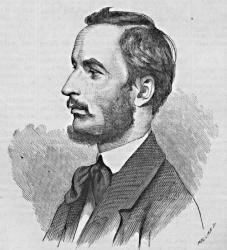
Vladimir Kozlovsky
- His Early Life and Artistic Influences
- Immersion in Impressionism
- Early Success and Recognition
- A Synthesis of Styles
- Involvement in Artistic Societies
- Later Life and Legacy
His Early Life and Artistic Influences
Vladimir Kozlovsky embarked on his artistic journey at the young age of 13, enrolling in the prestigious Moscow School of Painting, Sculpture, and Architecture. This institution, second only to the St. Petersburg Academy of Arts, had a profound influence on shaping the emerging Moscow school of painting.
Kozlovsky's early works drew inspiration from the lyrical landscape paintings of Alexei Kondratyevich Savrasov, who led the school's landscape studio. His successor, Vasily Dmitrievich Polenov, further nurtured Kozlovsky's talent, becoming his beloved mentor.
Immersion in Impressionism
Polenov introduced his students to the revolutionary ideas of Impressionism, showcasing reproductions of masterpieces by French artists. This exposure significantly influenced Kozlovsky's artistic trajectory, as well as that of other notable painters like Konstantin Korovin, Isaac Levitan, and Valentin Serov.
Early Success and Recognition
In 1886, after eight years of rigorous training, Vladimir Kozlovsky graduated as a non-class artist. Upon his return to his hometown of Kiev, he became a member of the Kiev Society for the Encouragement of the Arts and co-founded the renowned "Spring Exhibitions" held annually from 1892.
Kozlovsky's talent was recognized with numerous awards at these exhibitions. He received the third prize for "Quiet Abode" in 1892, the second prize for "In Native Lands" in 1893, and the coveted first prize for "Noon" in 1894. His painting "Pine Forest" earned him accolades at the V Exhibition of the Society of South Russian Artists in Moscow that same year.
A Synthesis of Styles
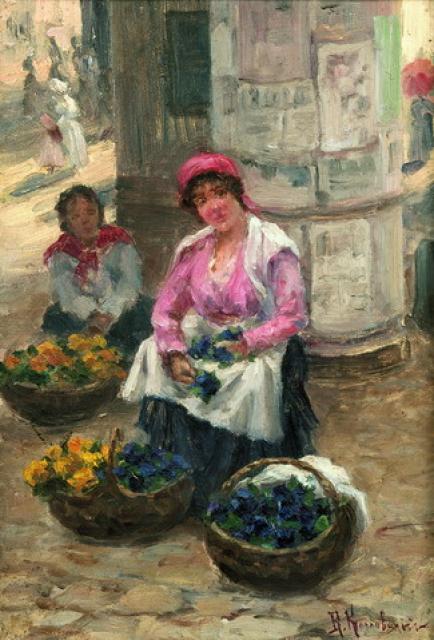
Kozlovsky's unique artistic style blended the lyrical landscapes of Savrasov and Polenov with the narrative elements of Perov and Pryanishnikov. He captured the essence of Ukrainian nature while infusing it with scenes of everyday life.
His works were exhibited extensively throughout Russia and Ukraine, including Moscow, St. Petersburg, Kiev, Odessa, Kharkov, and Zhitomir. Art enthusiasts had the opportunity to admire paintings such as "October Twilight," "To the City," and "Family" in 1914, and "Olesya," "On the Kiev-Zhitomir Highway," and "Malva" in 1915.
Involvement in Artistic Societies
In 1915, Vladimir Kozlovsky played a pivotal role in establishing the Society of Kiev Artists, serving as its secretary and board member. As the society's secretary, he facilitated connections between talented Kiev artists and numerous museums and galleries nationwide.
Several of Kozlovsky's works, including "Winter," "Fishermen," and "Road to Zhitomir," were immortalized on postcards published by the Kiev publishers "Rassvet" and "Den," introducing his art to the wider public.
Later Life and Legacy
In 1916, a jubilee exhibition in Kiev showcased Kozlovsky's artistic brilliance, featuring works like "Sophia Square," "Morning at the Farm," and "Lovers." His last notable recognition came in 1918 at a charitable exhibition in Kiev, where he displayed both traditional and avant-garde pieces.
With the advent of the October Revolution, the artistic landscape shifted dramatically. Impressionism faced increasing criticism, labeled as bourgeois and incompatible with the new socialist regime. Kozlovsky, like many other Russian Impressionists, endured a period of obscurity.
He spent the 1920s in Kiev, illustrating children's books for the same publishers that had once produced postcards of his paintings. Vladimir Ivanovich Kozlovsky passed away in 1930 and was laid to rest in the Old Baikove Cemetery in Kiev, leaving behind a lasting legacy as a gifted painter who embraced the beauty of the everyday.