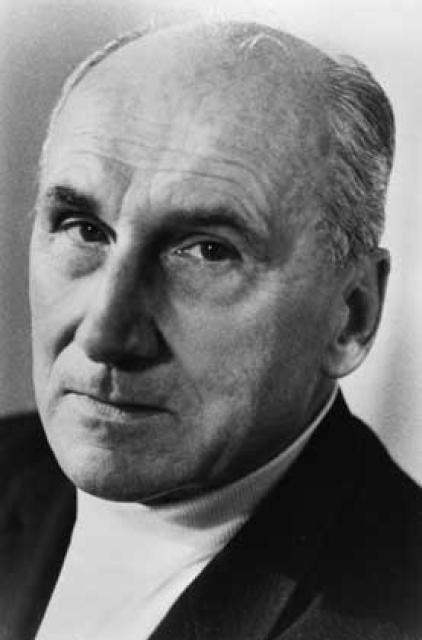
Vladimir Prelog
 Switzerland
- Vladimir Prelog: The Pioneer of Stereochemistry
- Early Life and Education
- Career in Zagreb and Switzerland
- Contributions to Stereochemistry
- Prelog's Rule and Nomenclature System
- Cyclostereoisomerism and Chemical Topology
- Nobel Prize and Legacy
- Retirement and Later Life
Vladimir Prelog: The Pioneer of Stereochemistry
Born on July 23, 1906, in Sarajevo, Bosnia and Herzegovina, Vladimir Prelog was a renowned Swiss organic chemist who revolutionized the field of stereochemistry.
Early Life and Education
Prelog's family relocated to Zagreb during World War I, where he pursued his education. He obtained his chemical engineering degree in 1928 from Prague's Institute of Technology and his doctorate the following year.
Career in Zagreb and Switzerland
Despite the economic crisis that followed, Prelog found employment as a lecturer at the University of Zagreb, rising to the rank of adjunct professor within five years. In 1941, he synthesized adamantane, a molecule with a structure resembling diamond, which brought him international recognition.
Following the German invasion of Zagreb, Prelog emigrated to Switzerland with the support of Nobel laureates Richard Kuhn and Leopold Ružička. He became a private lecturer in 1942, an adjunct professor in 1947, and a full professor of organic chemistry in 1952.
Contributions to Stereochemistry
Prelog's research focused extensively on stereochemistry, the study of the three-dimensional arrangement of atoms in molecules. He investigated the stereochemistry of quinine and its isomers, leading to his pivotal observation of transannular effects in intramolecular reactions.
Prelog's Rule and Nomenclature System
In 1950, Prelog formulated his namesake rule, which describes the preferred conformation of optically active compounds during their transformations. Recognizing the challenges in describing and understanding stereoforms, Prelog collaborated with R.S. Cahn and C.K. Ingold to develop the Cahn-Ingold-Prelog system. This system systematizes the assignment of absolute configuration to molecules with multiple chiral centers.
Cyclostereoisomerism and Chemical Topology
Prelog's explorations also included the study of macrocyclic polypeptides, where he and his colleague H. Gerlach discovered cyclostereoisomerism, a new type of stereoisomerism. He delved further into stereochemistry by investigating the chemical topology of molecules and the theories of groups and graphs.
Nobel Prize and Legacy
In 1975, Prelog was awarded the Nobel Prize in Chemistry for his groundbreaking research in organic chemistry. He shared the award with John Cornforth. Prelog's work played a pivotal role in advancing the understanding of stereochemistry and its implications in biological processes.
Retirement and Later Life
Prelog retired from his position as director of the Federal Institute of Technology in Zurich in 1976. He remained on the board of directors of Ciba-Geigy, a Swiss pharmaceutical company, until 1985. Prelog passed away on January 7, 1998, leaving an enduring legacy in the field of chemistry.


