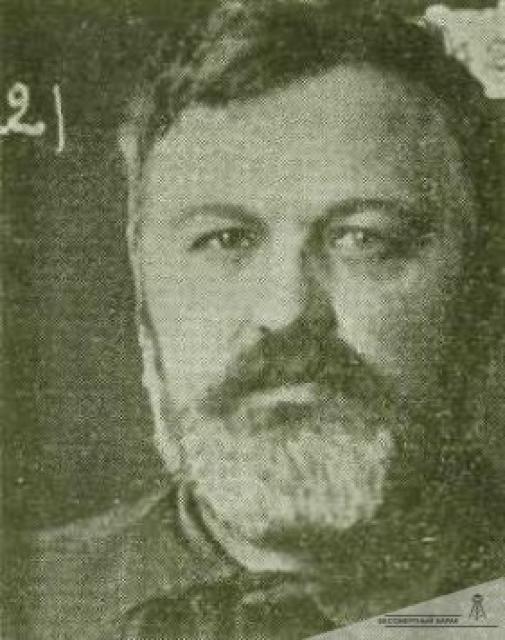
Vladimir Prokulevich
- Early Life and Education
- Political Involvement
- Legal Career and World War I
- Slutsk Uprising
- Emigration and Government Service
- Arrest and Imprisonment
- Legacy
Early Life and Education
Vladimir Mikhailovich Prokulevich was born on December 2, 1887, in Krasnoluki, a town in the Borisov district of present-day Belarus. He was the son of a zemstvo secretary and a teacher. Prokulevich received his early education at the Smolensk Gymnasium and later studied law at Moscow University from 1908 to 1912.
Political Involvement
While in Moscow, Prokulevich became involved in the social-democratic movement. He served as secretary for the Marxist journal "Vozrozhdenie" and as head of the chronicle department for the newspaper "Kopeyka." After returning to Borisov, he joined the local organization of the Bund (General Jewish Workers' Union). However, he later co-founded the Borisov branch of the Russian Social Democratic Labor Party (RSDRP) with like-minded individuals. He also became an active member of the Belarusian Socialist-Revolutionary Party.
Legal Career and World War I
From 1912, Prokulevich worked at the Minsk Treasury Chamber and later at the Minsk District Court. With the outbreak of World War I, he evacuated to Moscow but returned to Minsk in July 1917. He was sent to Slutsk, where he was elected chairman of the Slutsk Congress of magistrates in 1918. He served as a magistrate in the town of Vyzna from 1919 to 1920.
Slutsk Uprising
During his time in Slutsk, Prokulevich quickly became close with Pavel Zhavid, a fellow Socialist-Revolutionary. Prokulevich played a role in the 1920 Slutsk Uprising, serving as a member of the Presidium of the First Slutsk Congress. While initially advocating for a more moderate approach, he ultimately agreed to support the decision to resist the Red Army.
Emigration and Government Service
After the suppression of the uprising, Prokulevich moved to Vilnius in 1921. He became part of the Vilnius Belarusian National Committee but was expelled by Polish authorities in 1922 and relocated to Kaunas. In August 1923, he became State Secretary of the Belarusian People's Republic government led by Alexander Tsvikevich. In November 1923, the government members left Kaunas for Prague. However, in 1926, Prokulevich returned to Minsk and worked at the State Library of the Byelorussian SSR.
Arrest and Imprisonment
Prokulevich was arrested on July 18, 1930, on fabricated charges and sentenced to five years of exile in Perm. He was arrested again on January 9, 1938, and sentenced to death by an extrajudicial body. He was executed on August 20, 1938, in Sverdlovsk.
Legacy
Prokulevich was rehabilitated in 1988 and 1989. His "Memoir" provides valuable insights into the events he witnessed. Despite the circumstances under which it was written, researchers appreciate its wealth of factual information and historical significance. Prokulevich's legacy is a testament to the struggle for Belarusian independence and the complexities of political opposition during a turbulent period.