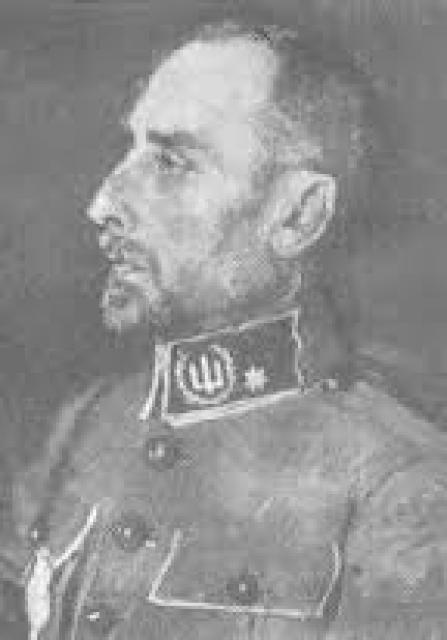
Vladimir Sinclair
- Early Life and Education
- Military Career in Russia
- World War I
- Service in Ukraine
- General Staff of the UNR
- Later Life
- Political Involvement and Imprisonment
Early Life and Education
Alexander Fyodorovich Skipetsky was born into the family of a military engineer. His ancestors, fleeing the English Revolution, sought refuge in Russia and entered the service of Tsar Alexei Mikhailovich. Skipetsky considered himself Ukrainian and later confirmed this during an interrogation in 1945.
Skipetsky graduated from the Neplyuevsky Cadet Corps, the Mikhailovsky Artillery School, and the Nikolaev Military Academy in 1905, where he studied alongside his future colleague Alexander Grekov.
Military Career in Russia
Russo-Japanese War and BeyondSkipetsky served in the Russo-Japanese War of 1904-1905, holding a staff position under the Commander-in-Chief in the Far East. After the war, he commanded a company in the Life Guards Pavlovsky Regiment and later served as an officer of the General Staff in the Guard Troops and St. Petersburg Military District.
World War I
During World War I, Skipetsky was Chief of Staff of the 37th Infantry Division and commanded a regiment. He was severely wounded in the head in 1916. He was awarded numerous decorations for his service, including the Orders of St. Stanislav, St. Anna, and St. Vladimir with swords.
Service in Ukraine
Ukrainian People's RepublicIn 1918, Skipetsky joined the General Staff of the Ukrainian People's Republic (UNR) and later became its Assistant Chief of Staff. He organized the army's operational apparatus and served as Chief of Staff of the Nadnya National Army of the UNR.
General Staff of the UNR
In March-July 1920, Skipetsky served as Chief of the General Staff of the UNR, where he developed a plan for reorganizing the army. However, Ukrainian troops were already stationed in Poland at that time, while Ukraine itself was controlled by the Red Army.
Later Life
Post-Military CareerAfter the failure of the Ukrainian resistance movement in 1922, Skipetsky retired from military activity. He worked in Boryspil, Ukraine, including as a weighman. He declined an offer to serve in the Polish Army.
Political Involvement and Imprisonment
Skipetsky was active in the Ukrainian Central Committee, which provided assistance to Ukrainian émigrés. He lectured on military pedagogy to former UNR soldiers. Due to heart problems, he was forced to retire in 1939.
In 1945, Skipetsky was arrested by SMERSH and interrogated. The military prosecutor recommended a 10-year prison sentence, but he died before the trial. He was transferred to the prison infirmary in March 1946 due to angina pectoris and passed away on March 16.



