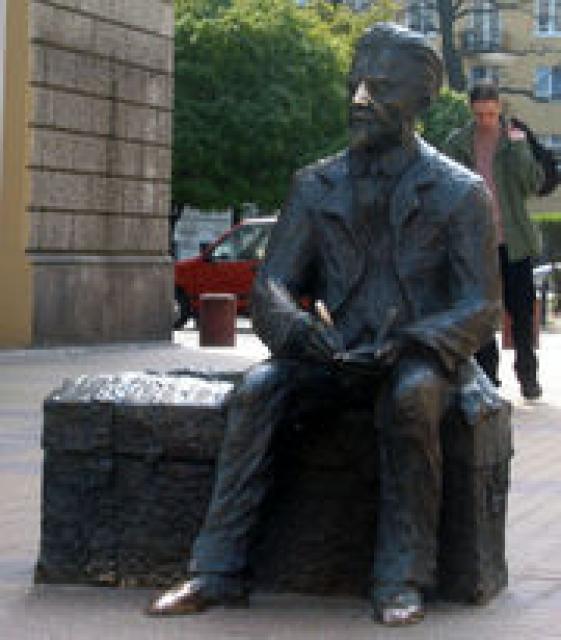
Vladislav Reymont
 Poland
Biography of Vladislav Reymont
Vladislav Reymont was a Polish writer and the recipient of the Nobel Prize in Literature in 1924.

Early Life
Reymont was born into the family of a rural organist. His parents wanted him to become a priest, but he left school and embarked on a series of different professions. He traveled extensively throughout Poland and Europe, working as a tailor's apprentice in Warsaw from 1880 to 1884 and as an actor in traveling troupes from 1884 to 1887. He also worked as a railway employee. In 1893, he settled in Warsaw and lived off his literary earnings. A substantial compensation from a road accident in 1900 helped him achieve financial independence.
Work
Reymont made his literary debut in 1893. His works combine the traditions of critical realism with elements of naturalism and symbolism. While he is primarily known as a novelist, he also wrote poems. His works encompass a wide range of themes and genres.
In his collections "Meeting" (1897) and "Before Dawn" (1902), as well as in the novella "Justly" (1899), Reymont depicted village life. His novels "The Comedienne" (1896) and "Ferment" (1897) portray the customs and manners of provincial officials and the acting community. The multi-plot novel "The Promised Land" (Volumes 1-2, 1899) recreates the development of capitalist Łódź, depicted from an anti-urban perspective, as well as the life of textile magnates in Łódź. The novel was adapted into a film by Andrzej Wajda in 1975.
The pinnacle of Reymont's work is considered to be the novel "The Peasants" (Volumes 1-4, 1904-1909; translated into Russian in 1954), which portrays rural life in terms of social contradictions and psychological conflicts. Reymont was awarded the Nobel Prize in Literature in 1924 for this novel, hailed as an "outstanding national epic." He also wrote the novel "The Vampire" (1911) and the historical trilogy "The Year 1794" (1913-1918) about Poland at the end of the 17th century and the national liberation uprising led by Tadeusz Kościuszko.


