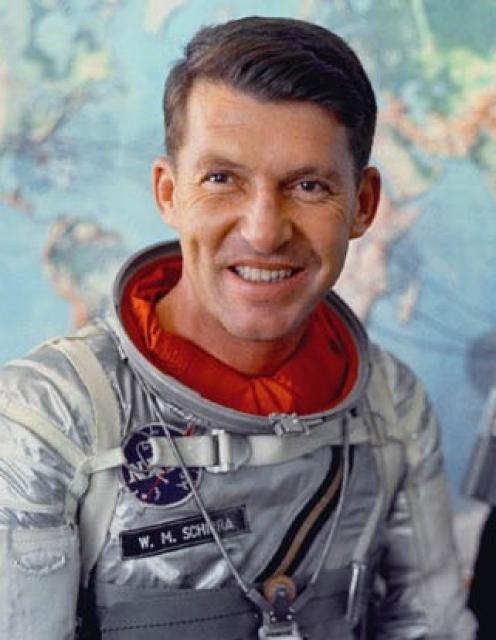
Walter Marty Schirra Jr.
 USA
USA- Biography of Walter Marty Schirra Jr.
- Early Life and Education
- Military Career
- Mercury Missions
- Gemini Missions
- Later Career
Biography of Walter Marty Schirra Jr.
Walter Marty Schirra Jr. was an American astronaut who achieved three space flights with a total duration of 12 days, 7 hours, 13 minutes, and 38 seconds. He was born in Hackensack, New Jersey on March 12, 1923.
Early Life and Education
In 1940, Schirra graduated from Dwight Morrow High School in Englewood. Following his high school graduation, he attended Newark College of Engineering and completed his studies there in 1941. Schirra then went on to graduate from the United States Naval Academy in Annapolis in 1945.
Military Career
After graduating from the Naval Academy, Schirra served on the cruiser USS Alaska from 1945. In February 1946, he joined the staff of the US Navy's 7th Fleet. In 1948, Schirra completed his flight training at Naval Air Station Pensacola and served in the 71st Fighter Squadron. From 1951 to 1952, he participated in the Korean War as a member of the 154th Fighter-Bomber Squadron, flying 90 combat missions on F-84E and achieving one aerial victory.
In 1952, Schirra was transferred to the China Lake Naval Air Weapons Station. Later, in 1958, he graduated from the U.S. Naval Test Pilot School at Naval Air Station Patuxent River. On April 9, 1959, he was selected to be part of NASA's first group of astronauts.
Mercury Missions
On November 29, 1961, Schirra became the backup pilot for Donald Slayton on the Mercury-Atlas 7 mission. After Slayton was removed from the flight lineup, Schirra became the backup for Scott Carpenter on Mercury-Atlas 7.
On June 27, 1962, Schirra was named as the pilot for the Mercury-Atlas 8 mission. On October 3, 1962, he successfully completed an orbital space flight aboard the Mercury spacecraft. The mission lasted 9 hours, 13 minutes, and 11 seconds, and all objectives were accomplished.
Gemini Missions
In August 1963, Schirra and John Young were assigned to the Gemini 5 crew. However, the planned docking with an Agena target vehicle was canceled. Instead, they became the backup crew for the Gemini 3 mission commanded by Alan Shepard and Thomas Stafford.
On April 13, 1964, Schirra and Stafford were reassigned as backups for Virgil Grissom and John Young on Gemini 3. In April 1965, Schirra and Stafford were assigned to the Gemini 6 crew. However, the initial launch attempt on December 12, 1965, was unsuccessful. The mission was eventually launched on December 15, and it lasted 1 day, 1 hour, 51 minutes, and 24 seconds. During this mission, the first rendezvous of two manned spacecraft took place.
Later Career
On October 11, 1968, Schirra commanded the Apollo 7 mission along with Walter Cunningham and Donn Eisele. This flight marked the first manned mission of the Apollo program and lasted 10 days, 20 hours, 9 minutes, and 3 seconds.
Throughout his career, Schirra received multiple accolades for his contributions. He was awarded the Navy's Distinguished Service Medal and received two NASA Distinguished Service Medals.
Walter Marty Schirra Jr. passed away on May 3, 2007, in La Jolla, California, leaving behind a remarkable legacy in the field of space exploration.