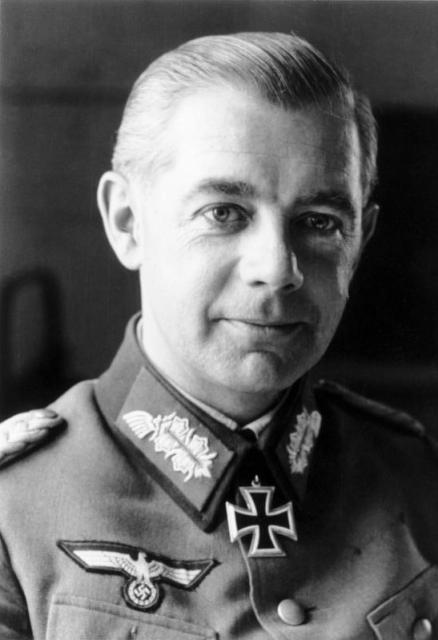
Walther Wenck
 Germany
Biography of Walter Wenck
Walter Wenck, one of the youngest generals in the German army during World War II, was born in Wittenberg, Germany. He was the third son of officer Maximilian Wenck. In 1911, he joined the Naumburg Cadet Corps of the Prussian Army. From spring 1918, he attended the Military School in Gross-Lichterfelde. During this time, Wenck served in the Freikorps and was wounded during the storming of a newspaper publishing house in February 1919.
On May 1, 1920, Wenck became a private in the 5th Infantry Regiment of the Reichswehr, and on February 1, 1923, he was promoted to the rank of non-commissioned officer. In February 1923, he graduated from the Infantry School in Munich and served as an adjutant to Hans von Seeckt. Wenck entered the Second World War as a major. On September 18, 1939, he received the Iron Cross 2nd Class, followed by the Iron Cross 1st Class on October 4.
From 1939 to 1942, Wenck served as the Chief of Operations in the 1st Panzer Division. In 1940, he was promoted to the rank of colonel for the rapid capture of the city of Belfort. On December 28, 1942, he was awarded the Knight's Cross of the Iron Cross and promoted to the rank of Major General on March 1, 1943. In 1942, Wenck served as an instructor at the War Academy, Chief of Staff of the 57th Tank Corps, and Chief of Staff of the 3rd Romanian Army on the Eastern Front. From 1942 to 1943, he served as Chief of Staff of the Army Group "Hollidt" (later reformed into the 6th Army), attached to the same 3rd Romanian Army.
In 1943, Wenck became the Chief of Staff of the 6th Army and from 1943 to 1944, he held the position of Chief of Staff of the 1st Tank Army. In 1943, he led his 1st Army out of the Kamenets-Podolsky pocket. In 1944, he served as the Chief of Staff of Army Group "South Ukraine".
On February 15, 1945, at the insistence of Heinz Guderian, Wenck commanded the German forces involved in Operation "Sonnenwende" (Sunrise). This was one of the last tank offensives of the Third Reich, with approximately 1,200 German tanks attacking Soviet positions in Pomerania. However, the operation was poorly planned, lacked sufficient support, and ended in defeat on February 18. In February 1945, Wenck suffered serious injuries in a car accident, fracturing five ribs. He had to wear a corset as a result.
On April 10, 1945, as a general of tank troops, Wenck commanded the 12th Army, located west of Berlin. Their task was to defend Berlin from the advancing Allied forces on the Western Front. However, as the Western Front forces moved east and vice versa, the German forces, acting as opposing fronts, were effectively squeezed together. As a result, a large camp of German refugees fleeing the approaching Soviet forces appeared behind Wenck's army, to the east of the Elbe River. Wenck made every effort to provide the refugees with food and shelter. According to various estimates, the 12th Army provided food for more than a quarter of a million people daily for some time.
On April 21, Hitler ordered SS Oberstgruppenfuhrer and General of Waffen-SS Felix Steiner to attack the positions of Marshal Zhukov's 1st Belorussian Front. Zhukov's forces surrounded Berlin from the north, while the 1st Ukrainian Front under Marshal Konev approached from the south. Steiner, with only a few operational tanks and approximately one division of infantry, refused to carry out the attack. Instead, he retreated to avoid being encircled and completely destroyed.


