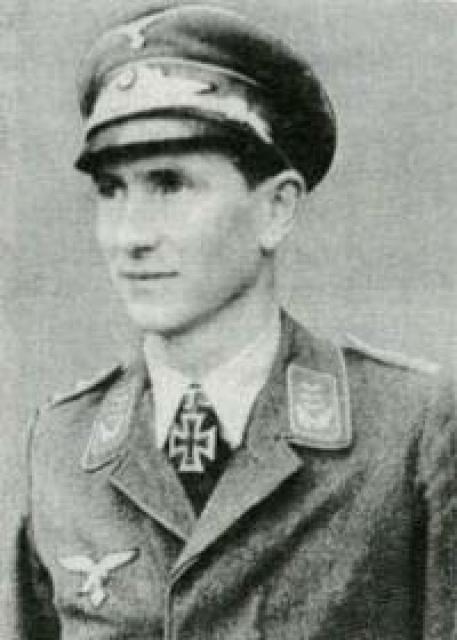
Wilhelm Baltazar
 Germany
- Wilhelm Baltazar: A Legendary Luftwaffe Fighter Pilot
- Early Career and Spanish Civil War
- France and Battle of Britain
- Continued Service and Death
Wilhelm Baltazar: A Legendary Luftwaffe Fighter Pilot
Wilhelm Baltazar was born on February 2, 1914, in Fulda, Germany. His father, a captain and a fighter pilot, tragically died in Flanders ten months after Wilhelm's birth, unaware that his son would follow in his footsteps. Tall and slender, Baltazar had an appearance that seemed to transport him from the Middle Ages. He displayed nobility by insisting that the enemy pilots he shot down be brought to his headquarters before being sent to prisoner of war camps, where he would offer them wine or schnapps. Baltazar also showed care for his fellow younger pilots and was renowned for his exceptional skills as a flight instructor.
Early Career and Spanish Civil War
Baltazar joined the Luftwaffe in 1935 and took part in combat for the first time in 1937 as part of the "Condor" Legion in the Spanish Civil War. He initially flew outdated He 51 fighters before transitioning to the new Bf 109. On January 20, 1938, he scored his first victory by shooting down a Soviet-made I-16 aircraft. Just a week later, in a six-minute battle, Baltazar destroyed four enemy planes. Before returning to Germany, his list of victories grew by two more aircraft.
France and Battle of Britain
Following his service in Spain, Baltazar became the commander of the 7th Squadron in the JG-27 and distinguished himself in France. On June 6, 1940, he singlehandedly shot down nine French aircraft, and on June 14, the day of Paris' fall, he became the second Luftwaffe representative to receive the Knight's Cross. Baltazar's combat achievements during the conquest of France included 23 French and British aircraft shot down and an additional 13 destroyed on the ground. During the Battle of Britain, Baltazar commanded the 111th Group (Gruppe) in the JG-27. On September 4, 1940, he was seriously wounded but still received a promotion to commander of the "Richthofen" Wing, replacing Major Helmut Wick, who was shot down over the English Channel on November 28, 1940.
Continued Service and Death
In May 1941, while most of the Luftwaffe was being deployed to the Eastern Front for the impending invasion of the Soviet Union, the "Richthofen" Wing remained in France to counter the Royal Air Force. Despite his lingering injury, Baltazar shot down the 39th and 40th enemy aircraft. In June 1941, new Bf 109F4 planes replaced the outdated models in France. Renowned not only for his flying skills but also for his technical knowledge, Baltazar expressed disapproval of the new version of the German fighter due to its weak wings and susceptibility to flutter. As expected, Baltazar decided to personally test the new aircraft. On July 3, while engaged in aerial combat near Azbrouck, his Messerschmitt unexpectedly entered a spin and crashed into the ground. Wilhelm Baltazar's death was instantaneous. Investigation into his death revealed no bullet holes in the plane, attributing the crash to wing failure during the combat maneuver.
At the time of his death, Baltazar had achieved 40 victories, including 7 during his time in the "Condor" Legion. Although he never received the Oak Leaves to the Knight's Cross, he was posthumously promoted to Major. In accordance with his wishes, Baltazar's comrades buried him near Abbeville, France, next to his father's grave—a man he had never met but whose path he unknowingly followed.


