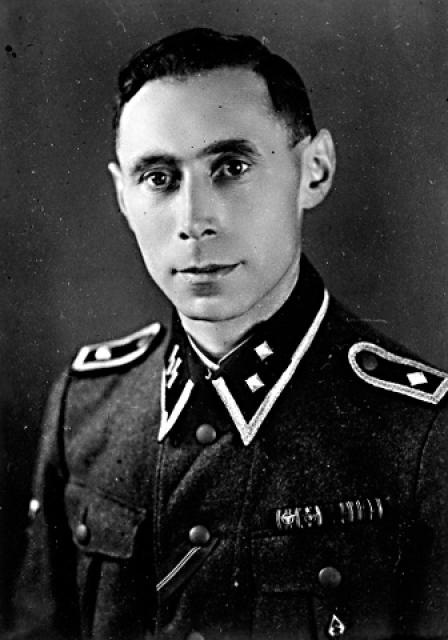
Wilhelm Friedrich Boger
 Germany
Biography of Wilhelm Boger
Wilhelm Boger was a Nazi police officer and supervisor of a concentration camp. He is best known for his crimes committed in Auschwitz under the direct supervision of his superior, Austrian Gestapo officer Maximilian Grabner. Born in Stuttgart, Germany, Boger joined the Hitler Youth as a teenager. After completing school, he found employment as a clerk and later joined the Nazi Party. In 1932, Boger lost his job and soon after obtained a position in the police force. From 1936 to 1937, Wilhelm received training at the police academy and subsequently became a commissioner.
Early Career
At the outbreak of World War II, Boger was transferred to a police station in Zichenau, and later appointed as the leader and observer of a border police station. In 1940, he joined the SS police engineering unit based in Dresden and was sent to the front. In 1942, Boger was seriously wounded and after nine months, he was transferred to Auschwitz as an untersturmführer in the local political department.
Crimes in Auschwitz
In Auschwitz, Wilhelm Boger invented the "Boger swing," a notorious torture device. It consisted of a one-meter iron rod suspended from the ceiling by iron chains. Detainees would be thrown over the rod and handcuffed. The swinging motion of the rod, inflicted by a guard armed with an iron bar, would cause increasingly severe injuries as Boger interrogated the prisoners. This brutal torture technique continued until the liberation of Auschwitz in January 1945. Boger remained in hiding for five years after the war until his arrest in 1946. He was intended to be extradited to Poland to face trial but managed to escape from custody.
Later Years and Death
In 1948, Boger settled in Crailsheim and two years later, he found employment at an aviation factory in Stuttgart. However, his peaceful life was short-lived as he was rearrested in 1958. This time, Wilhelm could not avoid standing trial, and after a series of witness testimonies, he was sentenced to life imprisonment. His "ingenious invention" came at a high price. Nineteen years of imprisonment left the former police officer as a broken old man, desperately pleading with guards to allow him to see his grandchildren. However, his pleas were in vain as his relatives categorically refused to have any contact with the fascist executioner. Multiple appeals for early release were also unsuccessful. Wilhelm Boger passed away in prison on April 3, 1977, at the age of 70.


