
Wiliam Govard Taft
 USA
USABiography of William Howard Taft
William Howard Taft was the 27th President of the United States, representing the Republican Party. He was also a Supreme Court Justice. Born on September 15, 1857 in Cincinnati, Ohio, Taft had a successful career in public service before becoming President. He attended school in his hometown and went on to study at Yale University, where he earned a degree in 1878. He then pursued a legal education at the Cincinnati Law School. In 1880, he was admitted to the bar and in 1881, he began his career in public service, becoming a judge on the Supreme Court of Ohio in 1887. In 1890, President Harrison appointed him as the Solicitor General of the United States. After returning to Cincinnati in 1892, Taft served as a judge on the United States Court of Appeals for eight years. In 1900, President McKinley appointed him as the President of the Second Philippine Commission, which was tasked with drafting a constitution for the archipelago, which had been occupied by American forces since 1898. A year later, he became the first civilian Governor-General of the Philippines, a position that required diplomatic skill due to the Filipino resistance to American occupation. From 1904 to 1908, he served as Secretary of War in President Roosevelt's cabinet. In June 1908, he was chosen by the Republican Party as their candidate for President, following Roosevelt's recommendation. In the November 1908 election, he and his Vice Presidential candidate, Senator James Sherman of New York, defeated the Democratic candidate, William Jennings Bryan. However, Taft's extensive experience in public service did not guarantee success in the presidency. He was often criticized for his indecisiveness and lethargy, earning him the nickname of a "bungler" during his presidency. In 1912, he lost the presidential election to his Democratic opponent, Woodrow Wilson, after a split in his own party and Roosevelt running against him as a candidate of the progressive wing. This marked the end of Republican dominance in Washington. The reasons for Taft's failure can be attributed to his character, his relationship with Roosevelt, the state of the Republican Party, and most importantly, his political preferences and decisions.
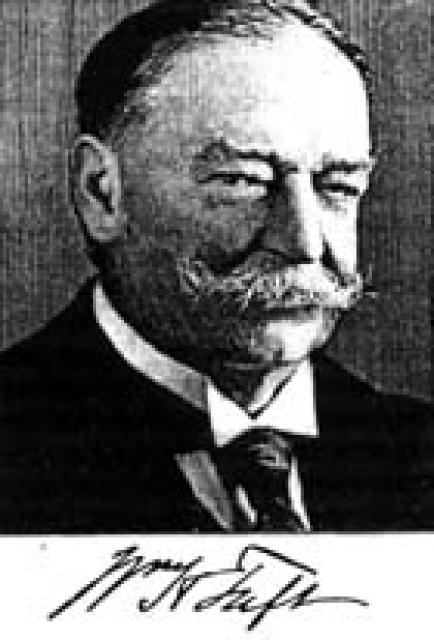
Early Life and Family
William Howard Taft grew up in a loving and protective environment in Cincinnati. He was one of seven children born to respected judge Alphonso Taft and his second wife, Louise Maria Torrey. Taft's parents instilled in him conservative values, combined with a strong sense of individualism and a sensitive social conscience. He was known as a kind, intelligent, and optimistic young man. From a young age, he struggled with the influence of others and had a fear of conflict and a passive nature, which later manifested as bouts of depression during his presidency. In 1886, Taft married his highly intelligent and charming wife, Helen Herron, who supported his ambitions and dreamed of him becoming President. Taft initially aimed for the position of Chief Justice of the Supreme Court, reflecting his realistic assessment of his abilities and character, which lacked political charisma. However, influenced by his wife and financially supported by his brother, Charles, Taft accepted the Republican Party's nomination for President.
Presidency
During his presidency, Taft struggled to escape the shadow of his predecessor, Roosevelt. Roosevelt's achievements set the standard by which Taft measured himself and was measured by the public. Despite their contrasting personalities, Taft and Roosevelt were friends both politically and privately. Roosevelt appreciated Taft's friendly and unhurried nature, his integrity, sharp legal mind, and unwavering loyalty. Taft enjoyed the friendship and the position of trust he held as one of Roosevelt's closest advisors. They shared Republican-Democratic values and were both actively involved in renewing the country. However, Taft consistently held more conservative positions. Roosevelt believed that Taft would continue his reform policies as President.
Taft's initial goal was to consolidate Roosevelt's reforms, mostly aligning with the conservative wing of his party - supporters of maintaining party traditions. He clashed with the progressive wing of the Republicans, known as the "insurgents," led by Senator Robert M. La Follette, who referred to Roosevelt's reforms. The first major conflict between Taft and Roosevelt arose when Taft formed his cabinet. Roosevelt expected Taft to demonstrate political continuity in his appointments, but he was disappointed. Instead of selecting members from the old guard for key positions, Taft appointed individuals from his own circle of trusted associates, including two Democrats. Conservative lawyers with close ties to big industry dominated his cabinet. Taft faced criticism from progressive reformers after appointing Richard A. Ballinger as Secretary of the Interior, as he reviewed Roosevelt's conservation policy in the West and aimed to return most of the federally protected forest lands to private ownership. However, it is important to note that Taft continued many of Roosevelt's initiated reforms and pursued new ones. He implemented a difficult postal reform and created the Postal Savings System, advanced the reform of federal administration with merit-based pay, and established a separate department for Commerce and Labor, which aimed to restrict child labor. In 1910, the Mann-Elkins Act expanded government control over the railroad companies. Taft took a much more vigorous stance than Roosevelt in antitrust suits heard by the courts, despite his friendly disposition towards entrepreneurs. This uncompromising antitrust policy weakened his political foundation within the Republican Party and among close business allies.
Taft's most significant domestic policy goal was the long-awaited reform of the tariff. The high tariffs of the Dingley Act of 1897 were to be lowered. Roosevelt deliberately avoided this challenging task. The Republican wing that advocated high protective tariffs and resisted tariff reform was formed by representatives of the industrial sector, whose central interest was protecting the American market from cheap products of their European competitors. They approved of tariff reductions on imported raw materials. The progressive wing represented the interests of agriculture and some manufacturing industries that aimed to increase exports by liberalizing foreign trade. The financial crisis in the fall of 1907 and the subsequent economic downturn made it more necessary than ever to change course in economic and financial policy. However, supporters of party traditions blocked the increase in the inheritance tax and the introduction of an income tax, which were proposed as compensation for the loss of revenue from tariff reductions. In August 1909, the Payne-Aldrich Tariff Act was passed, largely fulfilling the desires of the "tariff" wing, despite the outcry from the progressives. The act was blamed for the sharp increase in the cost of living in 1909, which further fueled public dissatisfaction. The wave of strikes in 1910 openly revealed widespread discontent.
In foreign policy, Taft pursued his own path. Despite repeated warnings from Roosevelt about the impact of California's racially discriminatory legislation on relations with Japan and the political danger in East Asia, neither Taft nor Knox were willing to continue the restrained policy towards Japan and tolerate Japanese expansion in China. On the contrary, both were convinced that nothing could suppress the "Japanese danger to the Far East" more effectively than the dominance of American banks and enterprises in China. Under the "dollar diplomacy," American capital was supposed to promote China's economic development, leading to political stability and strengthening American influence. This policy aimed to put an end to the efforts of colonial powers to divide China into spheres of interest. The myth of unlimited sales opportunities in the Chinese market served as an important incentive, while missionary societies working in China developed a perception of a special relationship between their country and the "Middle Kingdom." The government, rather than Wall Street, was the driving force behind the China policy. Only the government's determination and guarantees prompted American financiers to engage in risky dealings with China. With Knox's energetic pressure on the Chinese government, he managed to secure the participation of American banks in a major railroad project, the Hankou-Zhengzhou Railway, despite the resistance of European powers. His plan to neutralize the railways in Manchuria aimed to eliminate Russian and Japanese influence. However, attempts to pit England and Germany against Russia and Japan failed, as both states did not want to be subject to American policy in China due to the tense situation in Europe. When Russia and Japan reached an agreement on their interests in Manchuria on July 4, 1910, in response to American intervention attempts, Knox's policy suffered a heavy blow. In 1911, American banks managed to lead the so-called Six Power Consortium for the reform of the Chinese currency. However, all major powers were angered by aggressive American policies in China. Ultimately, the moral justification for the "special relationship" served as a cover for state political goals when Taft's government, along with other major powers, opposed China's aspirations for independence. In 1911, after the start of the revolution and the overthrow of the imperial house, they refused to recognize the new government. The revolution put an end to further American expansion projects. In March 1913, American banks withdrew from the consortium of six when President Woodrow Wilson's new administration rejected further guarantees for American capital and instead recognized the new Chinese government under Yuan Shikai.
Taft's belief in the blessings of liberal-democratic noninterference was clearly demonstrated in his "dollar diplomacy" in Latin America. In the restless states of Central America, especially, "cannonballs had to be replaced with dollars" to achieve political stability. However, in Nicaragua in 1912, this attempt to achieve stability only resulted in the deployment of American naval forces. Knox's efforts to impose American customs control on Nicaragua, as he had done in the Dominican Republic under Roosevelt, also failed when the American Senate refused approval. A similar fate befell Taft's attempts to control the finances of Honduras with the help of American banks. However, American influence in Honduras increased as the new Nicaraguan president Adolfo Diaz was merely a puppet supported by the presence of American troops. Knox also carried out armed intervention in the Dominican Republic from 1911 to 1913, after the expectation that the American customs control established in 1907 would bring about political stabilization failed, leading to the overthrow of the government and the start of bloody riots. However, the failure of Dominican customs control and the Mexican Revolution, which began in 1910, could not shake Taft's belief in the benefits of American investments for neighboring Latin American countries. In fact, the Mexican Revolution was a typical example of the explosive force of one-sided economic development, primarily financed by American capital. Taft responded with concern to the growing anti-American sentiment in Mexico and mobilized American armed forces. The end of his presidency spared Taft from further involvement in the Mexican Revolution. Overall, the result of Taft's "dollar diplomacy" was a heavy loss of trust and prestige for the United States in Latin America. European great powers also reacted to Taft's Latin American policy with annoyance, no less than his Chinese projects. Only the growing polarization in Europe, especially the Anglo-German antagonism, prevented more acute disagreements. Even in negotiations for new arbitration treaties with European powers in 1912, Taft was unsuccessful. He demanded too much from European treaty partners and his own political allies, aiming to make the arbitration procedure mandatory for all international conflicts. Roosevelt and Senator Henry Cabot Lodge strongly opposed touching on issues of national "honor, independence, and inviolability" in the arbitration procedure, and the Senate rejected the negotiated agreements with France and Britain.


