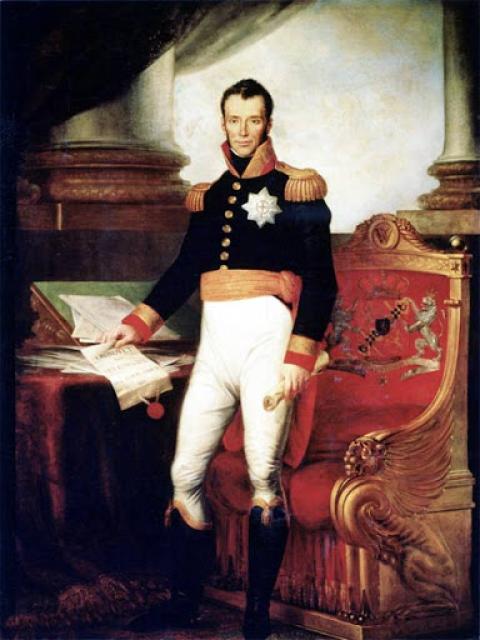
Willem I
 Netherlands
- William I: The First King of the Netherlands
- Early Life and Military Career
- Napoleonic Wars
- Liberation of the Netherlands
- Formation of the Kingdom of the Netherlands
- Separation of Belgium
- Abdication
William I: The First King of the Netherlands
William I was the inaugural monarch of the Netherlands, reigning from March 16, 1815, to October 7, 1840. He also held the titles of Duke of Luxembourg from March 16 to June 9, 1815, and Grand Duke of Luxembourg from June 9, 1815, to October 7, 1840.
Early Life and Military Career
William I was born on August 24, 1772, in The Hague. He was the son of William V, Stadtholder of the Netherlands, and Wilhelmina of Prussia. In 1793, he assumed command of the Dutch army in the war against the French. The conflict ended in 1795 when French troops entered Amsterdam, forcing William I and his father to flee the country.
Napoleonic Wars
During the Napoleonic Wars, William I served in the Prussian army in 1806, where he was captured by the French. Napoleon I then stripped him of his lands. In 1809, he volunteered to join the army of Archduke Charles and fought in the Battle of Wagram.
Liberation of the Netherlands
After the Battle of Leipzig in 1813, William I traveled to England and remained there for a period. Following the successful liberation of the Netherlands by Alexander von Benckendorff, William I landed in Scheveningen with an English detachment. He was greeted as the leader of the entire nation.
Formation of the Kingdom of the Netherlands
The Congress of Vienna merged Belgium with the Netherlands, creating a unified kingdom. On March 16, 1815, William I was proclaimed King of the Netherlands and Grand Duke of Luxembourg in The Hague. He gave up his hereditary lands in Germany to Prussia and Nassau.
Separation of Belgium
William I resided in both Brussels and The Hague until the Belgian Revolution of 1830 led to the separation of the Southern and Northern Netherlands. William I stubbornly resisted recognizing Belgian independence, but he was eventually forced to accept the decision of the great powers in 1839.
Abdication
The enormous state debt incurred by William I's persistent policies made him increasingly unpopular. This unpopularity was further amplified by his affair with the Catholic Countess Henriette d'Oultremont. On October 7, 1840, he abdicated in favor of his eldest son, William II. He adopted the title Count of Nassau and moved to Berlin, where he married Countess d'Oultremont. William I passed away in 1843.