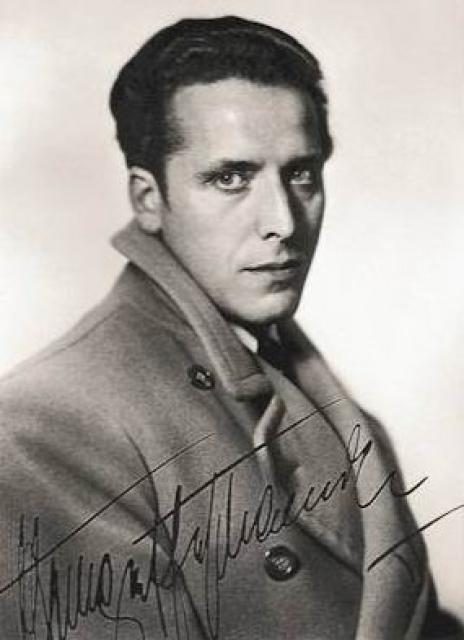
Willi Domgraf-Fassbaender
 Germany
- Early Life and Career
- Berlin and International Recognition
- Glyndebourne and Film
- Salzburg and Post-War Career
- Teaching and Legacy
Early Life and Career
Willi Domgraf-Fassbaender was born in Aachen, Germany, in 1897. Initially aspiring to become a conductor, he later pursued vocal studies and made his debut as an oratorio and concert singer. In 1922, his talent caught the attention of the Stadttheater Aachen, which offered him roles in opera and operetta.
Berlin and International Recognition
After his debut in Aachen, Domgraf-Fassbaender sang at the Deutsche Oper Berlin. Despite competition, he gained valuable experience and an expanded repertoire in Düsseldorf. In 1927, he joined the State Opera in Stuttgart, where he became a prominent performer. Encouraged by Richard Tauber, he returned to Berlin and established himself as a renowned "Italian baritone" and interpreter of Mozart.
Glyndebourne and Film
Domgraf-Fassbaender's reputation extended to the Glyndebourne Festival, where he performed in "The Marriage of Figaro" and "Così fan tutte" in the 1930s. His versatility also led to roles in musical films, including his acclaimed performance in "Die verkaufte Braut" in 1932.
Salzburg and Post-War Career
In 1937, Arturo Toscanini invited Domgraf-Fassbaender to sing Papageno at the Salzburg Festival. After World War II, he received the title of "Kammersänger" and became a sought-after guest at the Vienna State Opera.
Teaching and Legacy
In 1954, Domgraf-Fassbaender joined the Conservatory of Nuremberg as head of the opera school and vocal teacher. His daughter, Brigitte Fassbaender, a renowned mezzo-soprano, was his student. Domgraf-Fassbaender passed away in Nuremberg in 1978.


