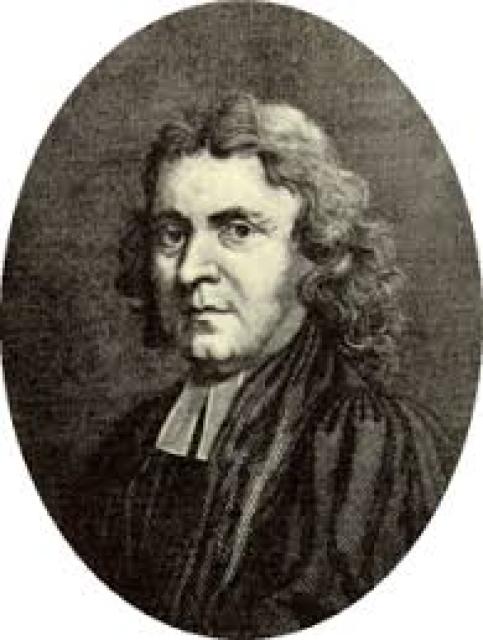
William Derham
 Great Britain
- William Derham: A Pioneer of Science and Faith
- Ordination and Ministry
- Scientific Contributions
- Wide-Ranging Observations
- Meteorology and Climate
- Discovery of Mineral Water
- Theological and Literary Works
- "Physico-Theology" and the Existence of God
- Editorship and Scientific Collaborations
- Legacy and Recognition
William Derham: A Pioneer of Science and Faith
Early Life and EducationBorn in Stoulton, Worcestershire, England, William Derham was an English priest, natural philosopher, and physicist. He received his education at Trinity College, Oxford, where he developed a passion for scientific inquiry.
Ordination and Ministry
Derham was ordained a priest in 1681 and served as vicar of Upminster, Essex, from 1689 until his death in 1735. During his ministry, he balanced his religious duties with his scientific pursuits.
Scientific Contributions
Measurements of Sound SpeedOne of Derham's most significant contributions was the first successful measurement of the speed of sound. By carefully timing the delay between a flash of light and the sound of a gunshot over a measured distance, he obtained an accurate value, which was later corrected by Newton.
Wide-Ranging Observations
Derham's scientific interests extended to a wide range of topics. He conducted observations on freckles, insects, bird migrations, and the behavior of mercury barometers. He also created a large collection of insects and birds at his rectory in Upminster.
Meteorology and Climate
Derham was a keen observer of weather patterns. He kept daily weather forecasts in Upminster and collected data on rainfall, making inferences about local and regional climate variations.
Discovery of Mineral Water
In 1708, Derham discovered a source of mineral water at Tylers Common. He analyzed its chemical composition and found it to contain dissolved iron sulfate.
Theological and Literary Works
"Artificial Clockmaker" and the Natural WorldIn 1696, Derham published his treatise "Artificial Clockmaker," which examined the design and functioning of clocks and other mechanical devices. This work highlighted his belief in the orderliness and predictability of the natural world.
"Physico-Theology" and the Existence of God
Between 1713 and 1730, Derham wrote three theological works known as "Physico-Theology," "Astro-Theology," and "Christo-Theology." These works presented teleological arguments for the existence and attributes of God, heavily influencing the later works of William Paley.
Editorship and Scientific Collaborations
Derham was the editor of the journal "Miscellanea curiosa medico-physica." He also compiled and published the letters of John Ray and prepared manuscripts by the natural philosopher Robert Hooke.
Legacy and Recognition
Derham was a close friend and collaborator of Isaac Newton. He was elected to the Royal Society of London in 1703 and became a canon of Windsor in 1716. His works not only advanced scientific knowledge but also fostered a deeper understanding of the relationship between science and faith.