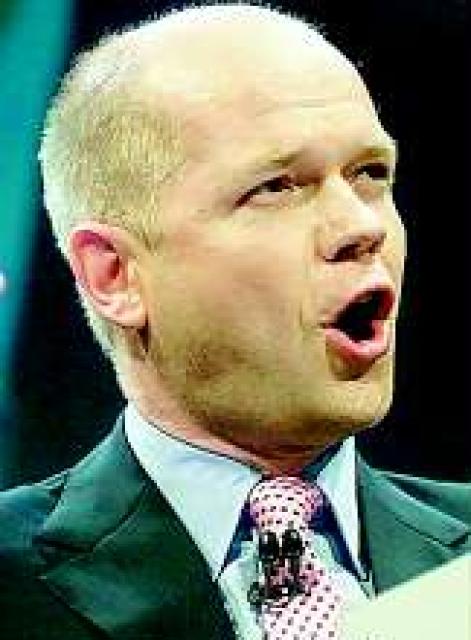
William Hague
 Great Britain
- Early Life and Education
- Parliament and Early Government Service
- Conservative Leader
- Historian and Return to Frontline Politics
- Foreign Secretary and Diplomacy
- Public Life After Parliament
- Personal Life and Legacy
William Hague is a British Conservative politician, historian and public commentator whose career has spanned frontline politics, diplomacy and university leadership. He led his party through its years in opposition after its 1997 election defeat, later served as Foreign Secretary in the coalition government, and became Chancellor of the University of Oxford in 2025.
Early Life and Education
Hague was born in Rotherham, Yorkshire, on 26 March 1961. He attended Wath-upon-Dearne Comprehensive School, where his interest in politics became clear early. At 16, he delivered a speech at the 1977 Conservative Party conference that attracted national attention. It marked him out as a precocious young political voice, though his family had no university background and he later described Oxford as a transformative step.
He entered Magdalen College, Oxford, in 1979, studying philosophy, politics and economics. He became president of both the Oxford Union debating society and the Oxford University Conservative Association, and graduated with first-class honours in 1982. Hague then attended INSEAD business school in France, earning an MBA with distinction in 1986. Between Oxford and his political career, he worked as a graduate trainee at Shell and as a management consultant at McKinsey, while also helping prepare speeches for Conservative politicians.
Parliament and Early Government Service
In 1989, at 27, Hague won a by-election to become the Conservative MP for Richmond in North Yorkshire. He held the seat through six general elections and rose quickly through the party. His early ministerial work included pensions and disability policy. As Minister for Disabled People, he helped steer the Disability Discrimination Act 1995 through Parliament, a major law that prohibited discrimination against disabled people in employment, transport and access to services.
In 1995, he became Secretary of State for Wales, then the youngest member of the Cabinet since Harold Wilson. During his time in the post, he worked on education, apprenticeships and environmental issues. He also met Ffion Jenkins, a civil servant in Wales. They married in 1997, the same year he moved into the highest position in his party.
Conservative Leader
After the Conservatives suffered a sweeping defeat to Labour in the 1997 general election, Hague was elected leader of the opposition at 36. His appointment made him one of the youngest leaders of a major British political party in modern history. He became known for his quick exchanges at Prime Minister’s Questions and for attempts to rebuild the party after its long period in office.
Hague could not turn around the Conservatives’ fortunes nationally. Labour, led by Tony Blair, remained popular, and the Conservatives lost the 2001 election. Hague resigned as party leader that September. He later described the role as a demanding form of public service that he did not regret taking on, even though it was among the least successful chapters of his career.
Historian and Return to Frontline Politics
After stepping down, Hague broadened his interests and established a second career as an author. His biography William Pitt the Younger was published in 2004 and won the History Book of the Year prize. His next major biography, William Wilberforce, followed in 2007. Both books reflected his interest in the history of political reform and public leadership.
Hague returned to the Conservative front bench under David Cameron, serving as Shadow Foreign Secretary from 2005. Following the 2010 general election, he led the Conservative negotiating team in discussions that produced a coalition government with the Liberal Democrats. He became Foreign Secretary and First Secretary of State.
Foreign Secretary and Diplomacy
From 2010 to 2014, Hague directed British foreign policy through a period of upheaval. His work ranged from the Arab Spring and the evacuation of British citizens from Egypt to the international response to the conflict in Libya and efforts to negotiate an agreement on Iran’s nuclear programme. He also spent substantial time seeking a diplomatic solution to the Syrian conflict.
One of his best-known initiatives was the Preventing Sexual Violence in Conflict Initiative, launched in 2012 with Angelina Jolie, then a special envoy of the United Nations refugee agency. The campaign sought to combat sexual violence in war, support survivors and reduce impunity for perpetrators. A major international summit in London in 2014 brought together governments, experts and advocates to coordinate action.
Hague left the Foreign Office in 2014, then served as Leader of the House of Commons for his final months in Parliament. He announced that he would not stand again and, after leaving the Commons in 2015, entered the House of Lords as Lord Hague of Richmond.
Public Life After Parliament
Since leaving elected politics, Hague has worked across business, journalism and public service. He has written a weekly column for The Times, advised organizations and taken leadership roles in institutions and charities. He chaired the Royal United Services Institute from 2015 to 2020 and the Royal Foundation from 2020 to 2025, and co-chairs United for Wildlife, a partnership working to disrupt the illegal wildlife trade. He has also co-authored reports with former prime minister Tony Blair on science, technology and innovation.
In November 2024, Oxford elected Hague as its Chancellor. He formally took up the largely ceremonial university office in February 2025, returning to the institution where his political ambitions had first taken shape. The appointment brought his public career back to one of its earliest influences: a university that introduced a young Yorkshire student to national debate and gave him the confidence to pursue a life in public service.
Personal Life and Legacy
Hague and his wife, Ffion, share an interest in libraries, gardens and conservation. His public persona has changed over time, from the teenage conference speaker to a party leader, diplomat, historian and university figure. His most enduring political achievements include disability rights legislation and international efforts to confront sexual violence in conflict. His later life has shown a capacity to move between politics and other institutions while remaining an active voice in British public debate.


