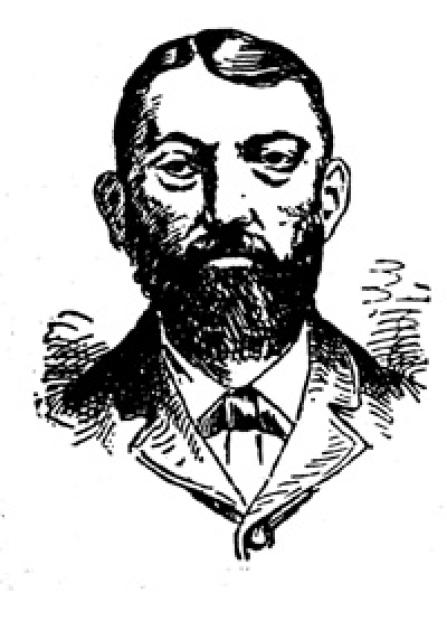
William Kemmler
 USA
USABiography of William Kemmler
William Kemmler was an American convicted murderer and the first person in the world to be executed by electric chair. He was born on May 9th, 1860 in Philadelphia, Pennsylvania. Both of his parents were German immigrants and alcoholics. His father died from an infection after a drunken fight, and his mother's cause of death remains unknown.
In his youth, William worked at his father's butcher shop after being expelled from school. After the death of his parents, Kemmler successfully engaged in small business and earned enough money to buy a horse and cart. However, by this time, he had already become an alcoholic himself. Kemmler spent his days in a drunken stupor, often getting into unpleasant situations.
Among his friends, Kemmler became known as 'Philadelphia Billy' due to his legendary binges, which he became famous for in all the saloons in his neighborhood of Buffalo. Kemmler was illiterate but spoke both English and German. On March 29th, 1889, he brutally murdered his common-law wife, Tillie Ziegler, with an ax, and was sentenced to death by electrocution at Auburn Prison in New York.
His lawyers argued that execution by electric chair was unconstitutional, cruel, and unusual. George Westinghouse, who studied alternating current, was also on the defense side and even hired the best attorneys for the appeal. However, their claims were rejected, partly due to the support of Thomas Edison, who wanted to prove with this execution that alternating current was much more dangerous than direct current.
The Execution
The first state electrician, Edwin Davis, was responsible for working out all the details of the electric chair. The execution began on the morning of August 6th, 1890, after Kemmler woke up at 5 am. He quickly got dressed in a suit, tie, and white shirt. After breakfast and saying his prayers, his hair was shaved on the crown of his head. At 6:38, Kemmler was taken to the execution room, and Warden Charles Durston presented him to 17 witnesses.
Kemmler inspected the chair and said, "Gentlemen, I wish you good luck. I believe I got a good place, and I am ready." Witnesses noted that Kemmler did not cry, scream, or resist. He simply sat in the chair, but the warden ordered a hole to be made in Kemmler's suit to attach a second electrical wire. The order was carried out, and Kemmler sat down again, this time tightly bound. Durston said, "Goodbye, William," and ordered the current to be turned on.
The generator delivered 1000 volts, which was considered enough to cause rapid loss of consciousness and stop the heart. The chairman had thoroughly tested the system by electrocuting a horse the day before the execution. The procedure lasted for 17 seconds, the power was cut off, and Dr. Edward Charles Spitzka pronounced Kemmler dead. However, witnesses noticed that Kemmler still showed signs of life.
Dr. Spitzka and Dr. Charles F. Macdonald examined the body and confirmed the witnesses' concerns. Spitzka shouted, "Could you please turn on the current again, quickly, without delay?" However, immediate recharging of the power source was not possible, and there are reports that Kemmler moaned during this time.
In the second attempt, a charge of 2000 volts was used. Blood vessels under the skin burst, and some witnesses mistakenly claimed that his body caught fire, which was not true. "The New York Times" reported that "a terrible smell began to emanate from the death room, and then the culmination of all this was a terrible sight: hair and flesh on the head and at the base of the spine, where the electrodes were attached, were singed. The stench was unbearable." According to eyewitnesses, the smell of burnt flesh was everywhere, and some witnesses vomited. The whole procedure took about 8 minutes.
Reporters from various newspapers competed with each other, filling the papers with sensational headlines and reports. One of them reported that everything that happened was "a revolting spectacle, much more horrifying than hanging." George Westinghouse, giving a comment, said, "They would have been better off using an ax."


