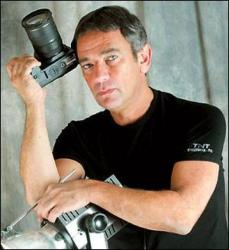
William Klein
 USA
USABiography of William Klein
William Klein, an American photographer, was born in 1928 in New York City, into a poor Jewish family. He excelled in school and entered City College of New York at the age of 14, where he studied sociology. After serving in the army in Germany and France, Klein enrolled in Sorbonne in Paris in 1948, where he studied abstract painting and sculpture. It was during this time that he met Fernand Léger, a famous French artist, sculptor, and director, who became Klein's mentor. This period marked Klein's search for his artistic direction. He became fascinated with abstract painting and sculpture, and in 1952, he held two exhibitions of his own work in Milan.
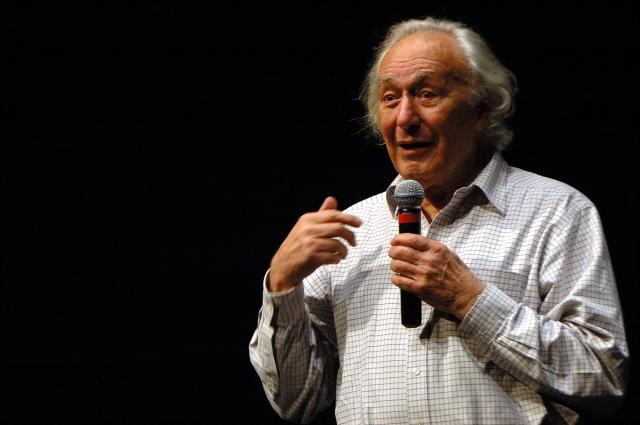
Klein's artistic experiments extended beyond sculpture, as he became increasingly interested in kinetic art. At one point, he was greatly influenced by Man Ray, who transformed photography into a completely new form of art. Interestingly, before this encounter, Klein saw photography as a practical art form, but over time, he started to take more and more photographs. Eventually, fate led him to Alexander Liberman, the art director of Vogue in New York.
Soon, Klein signed a new contract that brought him into the world of fashion photography. Interestingly, from the very beginning, Klein struggled with studio equipment and quickly found a solution by photographing his models directly on the streets. This innovative approach brought a touch of new light and style to the established genre, and William Klein's name became well-known. His photographs were revolutionary, not only changing Vogue magazine but also setting a new standard for the entire industry.
Moreover, Klein was the first to use mirrors in his photography, a technique that later became incredibly popular. He is credited with inventing "snapshot aesthetics" - capturing the spontaneous moment.
While continuing to shoot for glossy magazines, Klein also continued his street photography series. In the late 1950s, he shook the world of photography with his album "New York." He won the Prix Nadar for this work, and his name was mentioned alongside the patriarch of American street photography, Robert Frank. "New York" was a daily photo reportage, featuring street photographs randomly gathered together in a tabloid style. Interestingly, all American publishers he approached at the time refused to accept his material, finding the New York depicted in his photographs "rough," "vulgar," and "aggressive." Klein eventually published the book in Paris, and later it gained recognition in America.
In the early 1960s, Klein temporarily moved away from photography and became engrossed in filmmaking. He directed several experimental films, including "Who Are You, Polly Maggoo?" and "Mr. Freedom."
When asked about the difference between filmmaking and photography, Klein joked, "In movies, they carry all the equipment for you, and in photography, you have to carry everything yourself."
It is known that Klein has directed about twenty short and feature-length documentaries and has released over 250 television commercials.
In the 1980s, Klein returned to photography while still pursuing his interest in filmmaking. He mainly photographed on the streets, using wide-angle lenses. According to the publication "Professional Photographer," William Klein ranks 25th in the list of the "100 Most Influential Photographers."
Interestingly, many of his works were much more warmly received in France than in the United States. In a notable experiment, Klein and his assistants walked the streets of Paris and New York with a large sign that read, "Smile!" The reactions of Parisians and New Yorkers turned out to be completely opposite - while Americans smiled and laughed after reading the sign, Parisians frowned and looked away. This action was accompanied by a photoshoot that captured the reactions of both the French and Americans.
"I photograph what I see in front of me. To see better, I get as close as possible and use a wide-angle lens to capture a much larger space... There are no taboos in photography techniques: grain, contrast, blurring, incorrect composition, all sorts of accidents - let it be what it is," says William Klein.