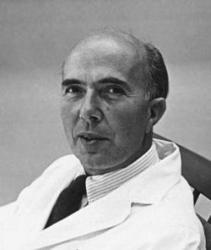
William Perry Murphy
 USA
- Education and medical training
- Research on pernicious anemia
- Nobel recognition and medical career
- Later years and legacy
William Parry Murphy was an American physician and medical researcher whose work helped turn pernicious anemia from a usually fatal illness into a treatable disease. He shared the 1934 Nobel Prize in Physiology or Medicine with George Richards Minot and George Hoyt Whipple for discoveries concerning liver therapy in cases of anemia.
Education and medical training
Murphy was born in Stoughton, Wisconsin, on 6 February 1892, the son of a Congregational minister. He completed his undergraduate studies at the University of Oregon, graduating in 1914, and then pursued medicine. A fellowship enabled him to attend Harvard Medical School, where he earned his medical degree in 1922.
After hospital training in Providence, Rhode Island, Murphy joined the Peter Bent Brigham Hospital in Boston. He also held appointments at Harvard Medical School, building a career that combined patient care with research into blood diseases.
Research on pernicious anemia
In the early twentieth century, pernicious anemia was a progressive and often fatal condition. George Minot recruited Murphy to survey and treat patients at the Brigham as part of research into whether diet could help. Their work built on George Whipple’s experiments, which had shown that liver could stimulate blood production in animals with anemia.
Murphy helped test a liver-rich diet with patients and carefully tracked their blood-cell responses. The treatment produced striking improvement, establishing liver therapy as an effective intervention for pernicious anemia. Later research identified vitamin B12 as the key nutrient in liver that corrected the deficiency, allowing treatment to become more precise.
Nobel recognition and medical career
In 1934, Murphy, Minot, and Whipple jointly received the Nobel Prize in Physiology or Medicine. The award recognized the importance of their treatment discovery, which changed medical practice and offered a lifeline to patients who previously had few options.
Murphy continued his work at the Peter Bent Brigham Hospital and Harvard, serving in senior medical roles and as a consultant in hematology. His research and clinical interests extended to other blood disorders, diabetes, and liver-extract treatment. He also published on the diagnosis and management of pernicious anemia.
Later years and legacy
Murphy married Pearl Harriet Adams in 1919, and their son later became a physician. He remained connected to medical practice and research for much of his life, as new discoveries refined the treatment that his work had helped establish.
He died on 9 October 1987, aged 95. Murphy’s contribution is remembered as a bridge between laboratory findings and patient care: by helping demonstrate that liver could restore blood production in people with pernicious anemia, he helped transform a devastating diagnosis into a manageable condition.