William Shockley
 USA
USA- Biography of William Shockley
- Early Life and Education
- Scientific Career and Inventions
- Entrepreneurial Ventures and Controversies
- Later Life and Death
Biography of William Shockley
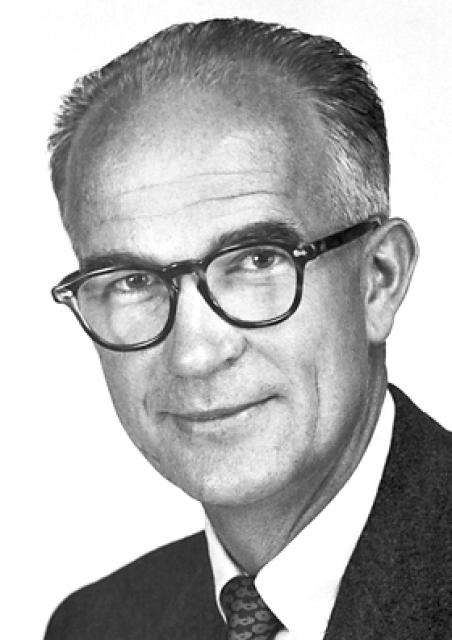
William Bradford Shockley Jr. was an American physicist and inventor, born in London, England, on February 14, 1910. His parents, William Hillman Shockley and Mary Bradford, were American citizens. At the age of three, Shockley moved with his family to Palo Alto, California, where he spent his childhood.

Early Life and Education
Shockley showed signs of both intellectual brilliance and mental instability from a young age. He experienced unpredictable fits of aggression, which escalated over time. Despite these challenges, he excelled academically. At the age of eight, Shockley enrolled in a military academy in Palo Alto, which had a positive impact on his behavior.

On May 26, 1927, Shockley's father passed away, leaving the family with sufficient means to live comfortably. Shockley Jr. earned a Bachelor of Science degree from the California Institute of Technology in 1932. In August 1933, he married Jean Bailey, and they had a daughter named Alison in March 1934. Shockley went on to earn his Ph.D. at the Massachusetts Institute of Technology (MIT) in 1936.
Scientific Career and Inventions
After completing his Ph.D., Shockley joined a research group led by Clinton Davisson at the Bell Labs in New Jersey. In 1938, he obtained his first patent. Shockley's peers at MIT recognized his brilliant mind but also noticed his inability to empathize with others. Some believe that during this period, Shockley began developing the idea of the "triumph of the intellectual elite."
Throughout his career, Shockley continued to innovate. In collaboration with John Bardeen and Walter Houser Brattain, he co-invented the transistor in the 1940s, a groundbreaking invention that revolutionized electronics. Their work on the transistor earned them the Nobel Prize in Physics in 1956.
Entrepreneurial Ventures and Controversies
In the 1950s and 1960s, Shockley attempted to profit from his new invention, leading to the rise of the California Silicon Valley as a hub of innovation in electronics. However, his business ventures were largely unsuccessful.
Later in his career, Shockley became interested in eugenics and became a staunch advocate. This controversial stance undermined his scientific reputation and made him a persona non grata in the scientific community. Furthermore, Shockley's authoritarian and paranoid management style in his production laboratory, funded by Arnold Beckman, alienated his colleagues.
Later Life and Death
By the 1960s, Shockley's laboratory was incurring significant financial losses. Despite its six-year existence, the laboratory failed to produce successful results. On July 23, 1961, Shockley was involved in a serious car accident, which left him on crutches for almost a year. It is believed that the injuries he sustained worsened his mental state.
In his final years, Shockley focused on the idea of human degeneration, but his contributions to the field of human heredity were minimal. He faced heavy criticism for his support of eugenics. Shockley passed away on August 12, 1989, from prostate cancer that had metastasized to his bones. In the months leading up to his death, he relied on morphine to manage his pain.