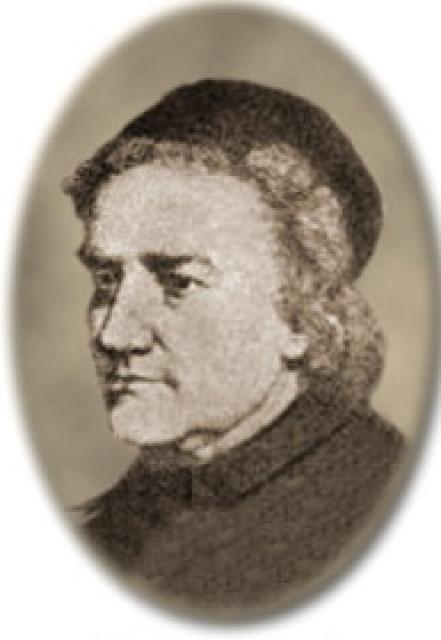
Witelo
 Poland
Biography of Vitelo
Vitelo, also known as Erazmus Ciolek Witelo, Witelon, Vitellio, Vitello Thuringopolonis, Vitulon, and Erazm Ciołek, was a German-Polish monk, theologian, and scholar. He was born around 1220-1230 in the village of Borek or Borow in Lower Silesia. His mother was from a Polish knightly family, while his father was a German settler from Thuringia. Vitelo referred to himself as "Thuringorum et Polonorum filius," meaning "son of the people of Thuringia and the Poles."
Vitelo studied at the University of Padua in the 1260s and later moved to Viterbo. He became friends with William of Moerbeke, a translator of Aristotle. Vitelo dedicated his main work in optics, titled "Perspectiva" or "Optics," consisting of 10 books and completed around 1270-1278, to William. This work was heavily influenced by the Arabic scholar Ibn al-Haytham's book on optics.
In "Optics," Vitelo combined a neoplatonic metaphysics of light with a focus on achieving mathematical accuracy in the study of nature. He constructed a prism to study the spectrum, which was considered the best of its time. Vitelo also explored the aesthetic value of colors and the qualitative aspects of observed objects. His work in optics had a significant impact on other scholars, including the German mathematician Johannes Kepler and the Italian polymath Leonardo da Vinci.
Vitelo's "Optics" included discussions on platonic metaphysics. He argued that there are intellectual and real, material bodies connected by the principle of causality, aligning with the main doctrine of idealist-platonists. For Vitelo, light was primarily rational beings, and his views on light are similar to those propagated by Roger Bacon, although they are closer in essence to the teachings of al-Haytham.
In addition to optics, Vitelo also wrote on psychology, presenting ideas that are close to modern notions of association of ideas and the subconscious. Many of Vitelo's other works have been lost, but his works "De Natura Daemonum" and "De Primaria Causa Paenitentiae" have been reconstructed.
Vitelo's contributions to science and optics have earned him recognition, including the naming of a crater on the moon after him.


