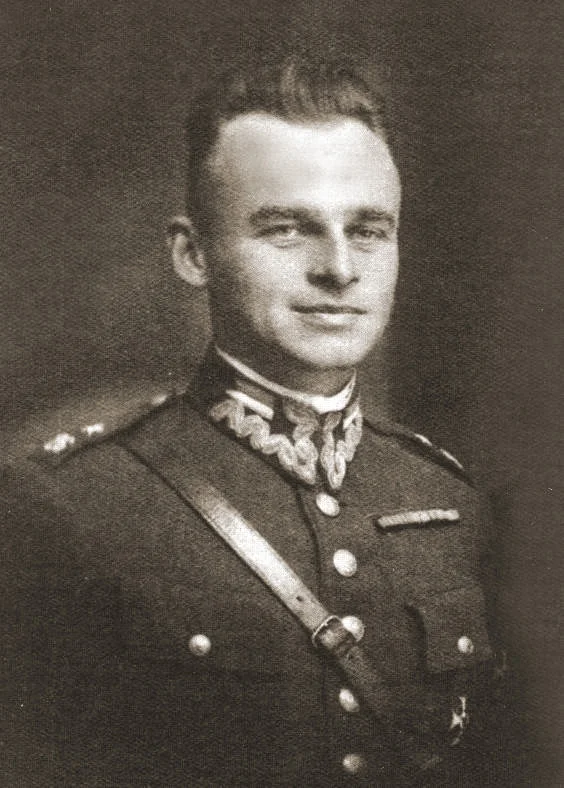
Witold Pilecki
- Soldier and resistance fighter
- A mission inside Auschwitz
- Warsaw Uprising and postwar mission
- Recognition and legacy
Witold Pilecki was a Polish cavalry officer and resistance organizer who volunteered for one of the most dangerous intelligence missions of the Second World War: entering Auschwitz as a prisoner. Inside the camp, he helped organize a clandestine network, gathered information about conditions and mass murder, and sent reports to the Polish underground. After escaping, he fought in the Warsaw Uprising and later returned to communist-controlled Poland, where he was arrested, tortured, and executed in a show trial.
Soldier and resistance fighter
Pilecki was born on 13 May 1901 in Olonets, in the Russian Empire, to a Polish family. He grew up in the Vilnius region and joined the Polish scout movement as a teenager. During the Polish-Soviet War of 1919–1921, he served in the Polish forces. Between the wars he managed his family’s estate and remained active in civic and military life.
After Germany invaded Poland in September 1939, Pilecki helped establish the Secret Polish Army, one of the early underground resistance organizations. When reports of arrests and deportations to Auschwitz began to circulate, he proposed entering the camp to learn what was happening and build a resistance network among prisoners.
A mission inside Auschwitz
On 19 September 1940, using the identity Tomasz Serafiński, Pilecki deliberately allowed himself to be caught in a German street roundup in Warsaw. He was deported to Auschwitz two days later. There he helped organize the Union of Military Organization, which provided mutual aid to prisoners, gathered intelligence, and sent reports to the Polish underground outside the camp.
Pilecki’s dispatches described starvation, disease, executions, and the camp’s expanding system of terror. As Auschwitz developed into a center of mass murder, the reports helped inform the Polish government-in-exile and Allied authorities about what was taking place. He hoped that the information might lead to an armed action to liberate the camp, but no such operation was mounted.
In April 1943, fearing that he could be exposed and wanting to press for action from outside, Pilecki escaped with two fellow prisoners. He later wrote a detailed account of his experience, now one of the most important firsthand testimonies about the early years of Auschwitz and its underground resistance.
Warsaw Uprising and postwar mission
After returning to the resistance, Pilecki served in the Warsaw Uprising, which began on 1 August 1944. When the uprising was defeated, he surrendered to German forces and was held in prisoner-of-war camps, including Murnau. After the war he served with the Polish forces in Italy.
In late 1945, Pilecki returned to Poland, then under the control of a communist government backed by the Soviet Union. He gathered intelligence about the new authorities and maintained contact with Polish networks abroad. The security services arrested him in 1947. During interrogation he was tortured, and in 1948 a military court sentenced him to death on charges including espionage. He was executed on 25 May 1948, aged forty-seven. His family was not told what had happened to him, and the authorities concealed his burial place.
Recognition and legacy
The communist regime suppressed Pilecki’s story for decades. His conviction was overturned in 1990, after the political changes that ended communist rule in Poland. He has since been recognized as one of the most courageous members of the Polish resistance.
Pilecki’s achievement was not only his decision to enter Auschwitz, but also the steady work he carried out there: supporting fellow prisoners, building a clandestine organization, and transmitting evidence of Nazi crimes at enormous personal risk. His reports remain a vital historical record, while his fate after the war stands as a reminder that liberation from Nazi occupation did not bring freedom to every Polish resistance fighter.


