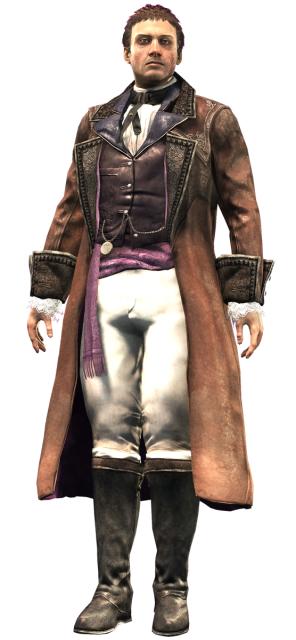
Woodes Rogers
 Italy
ItalyBiography of Woodes Rogers
Woodes Rogers, born in 1679 to a wealthy English merchant and captain named Woods Rogers, was known as a captain of a ship that saved Alexander Selkirk. Selkirk's fate, which is usually believed to have inspired Daniel Defoe to write the novel "Robinson Crusoe," was the basis of their encounter. As the eldest son, Woods took care of the household and relatives when his father went on voyages. At the same time, he managed to attend local schools, read extensively, and became fluent in several languages.

During his childhood, Woods lived in Poole, England, but later his family relocated to Bristol, England, where his father purchased a house. In November 1697, Rogers began his training in navigation under the command of experienced sailor John Yeamans. It is peculiar that Woods started his training at the age of 18, while most boys begin at 7-8 years old. Furthermore, his training lasted for more than five years, leading historians to question its accuracy. It is presumed that his father taught him the basics during his childhood, and the young sailor needed to confirm his skills and knowledge.
In 1704, his training was officially completed, and in January of the following year, the young captain married Sarah Whetstone, the daughter of Admiral William Whetstone, who was a close friend of the family. After celebrating his son's wedding, Woods set sail but was unable to return. He died at sea from an unknown illness, leaving his business, ships, and money to his son. Determined to follow in his father's footsteps, the son became one of England's most famous captains.
With the outbreak of the War of the Spanish Succession, some English ships were granted the right to capture and bombard Spanish and French vessels. Four ships from Rogers' fleet also obtained this privilege. However, one of his ships, the 'Whetstone Galley,' named after his father-in-law, was captured by the French after a prolonged naval battle. It is said that some other ships from Rogers' fleet fell into enemy hands, but there is no precise information about this since the captain did not record the lost vessels in his records. Fed up with this, Captain Rogers decided to become a privateer - a free captain who, with the permission of the supreme authority, was free to destroy and loot enemy ships.
In 1707, fate brought the captain together with William Dampier, a long-time friend of Woods' father, who was involved in similar activities. In his previous expedition, Dampier managed to capture a couple of Spanish ships, but on the way home, both were sunk due to his carelessness. Ignoring these failures, Rogers agreed to collaborate, and two new ships, the 'Duke' and the 'Duchess,' set sail from the port of Bristol. Troubles began shortly after leaving the port - part of the crew mutinied, and they were left in Ireland. It took over a month to recruit a new crew. Despite the majority of foreign sailors, including Dutch and Germans, a worthy crew was finally assembled after several months.
On January 31, 1709, the captain decided to stop at an island to replenish food and fresh water supplies. However, instead of finding water and fruits, they discovered a Scottish sailor named Alexander Selkirk. Selkirk had spent several years on the uninhabited island after his ship sank upon hitting an underwater reef. He became the prototype for the character Robinson Crusoe in Daniel Defoe's novel. According to Rogers' records, Selkirk resembled a wild man, dressed in animal skins and eating raw meat. However, he quickly adapted to human company and eventually became the captain of one of the captured ships. Alexander returned to England as a legend, an experienced sailor, and the captain of the 'Duke.' For another decade, Woods continued to sail the oceans and seas with his fleet. In one of his expeditions, he successfully captured several Spanish warships without losing any friendly vessels. After this triumph, he returned to England as a hero, a status he maintained until the end of his life.
During his expedition, Rogers wrote the book "A Cruising Voyage Round the World," which was and still remains popular. After the death of his father-in-law, financial problems began for the captain. He could no longer earn enough by capturing enemy ships, and some of his own ships were destroyed or in poor condition.
Following a successful expedition against pirates, Rogers arrived in Nassau, Bahamas, where mainly escaped pirates resided. Promising them amnesty if they surrendered to the English crown, he began rebuilding forts and improving the cities. He remained the governor of the Bahamas for two terms. Towards the end of his second term, Woods' health deteriorated, as he was exhausted from life on the islands and constant wars.
On July 15, 1732, Woodes Rogers passed away in his own home in Nassau. For two centuries after his death, the city's motto was, "Piracy expelled, trade restored" - the last words the captain uttered before his death.


