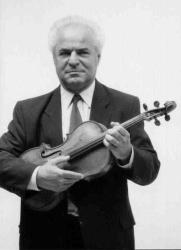
Yan Kubelik
- Jan Kubelík: Czech Violin Virtuoso
- Conservatory Education and Debut
- International Recognition
- The Rise of Skrzywan
- Russian Triumph and Artistic Maturity
- American Debut and Phenomenal Success
- International Stardom and Personal Life
- World War I and Decline
- Later Career and Legacy
Jan Kubelík: Czech Violin Virtuoso
Early Life and TalentJan Kubelík was born in Michle, near Prague, on July 5, 1880. His father, Josef-Matvej, was a violinist who performed in various ensembles at dance halls and hotel bars. Kubelík's father introduced him to music at a young age, purchasing him a violin when he was just four years old. The young boy quickly developed a passion for playing. Neighbors soon began to notice his talent, comparing him to renowned Czech violinist Ondržiček.
Conservatory Education and Debut
In 1892, Kubelík auditioned for the Prague Conservatory admissions committee with Beriot's Seventh Concerto. His performance impressed the panel, but his diminutive stature led to some hesitation. He was recommended to study under Otakar Ševčík for an additional year. Ševčík, who taught at the Prague Conservatory for only a year, immediately set Kubelík on a path of rigorous technical development.
By the age of 15, Kubelík had mastered Saint-Saëns' Third Concerto, performing it with great success. His brilliance in virtuosic pieces drew admiration from Ševčík, who proclaimed him the potential successor to Paganini. However, Kubelík's request for Beethoven's concerto was met with a Wenявский concerto instead. He eventually played Brahms' Concerto at his graduation exam, garnering praise from Prague newspapers.
International Recognition
Kubelík's breakout performance occurred in 1897 at a Vienna concert during a secondary cycling convention. He played Paganini's Concerto with such brilliance that critic B. Lvovsky wrote an enthusiastic review, hailing him as one of the world's finest violinists. This article caught the attention of wealthy Viennese businessman Josef Brosch, who hired Kubelík to teach his daughter. Soon after, he received an invitation from the Prague Philharmonic to perform Ernst's Concerto.
In 1899-1900, Kubelík embarked on his first international tours, traveling to Italy, Cannes, Monte-Carlo, and Nice. He took France by storm and subsequently ventured to London, where he was compelled to encore over an hour after completing his main program.
The Rise of Skrzywan
Kubelík's remarkable success attracted the attention of impresarios, most notably Rudolf Skrzywan. Skrzywan essentially took control of the violinist's life, isolating him from his family and friends. He ruthlessly exploited Kubelík's artistic talent, neglecting financial transparency and fostering dependence.
Russian Triumph and Artistic Maturity
In 1902, Kubelík conquered Russia. The "Russian Musical Gazette" hailed him as a "new darling" of the Petersburg public. Critics praised his exceptional technique and his ability to bring multi-part pieces to life, showcasing harmonic unity while clearly differentiating individual voices. In Paganini's works, he exhibited an effortless mastery of challenging effects, dazzling audiences with his command of harmonics and pizzicato.
American Debut and Phenomenal Success
Kubelík's first United States tour in 1902, arranged by Froman and Gorlitz, guaranteed him half a million crowns. To his surprise, he encountered promotional posters on the "Oceanic" that hailed him as the "New Paganini." Concerts in New York, Philadelphia, Chicago, and Washington proved immensely successful, earning him a substantial fortune of $22,000.
International Stardom and Personal Life
Throughout his career, Kubelík led a nomadic existence, performing extensively in Europe, Russia (where he toured five times before World War I), the United States (with seven concert tours), Australia, New Zealand, South America, and Cuba. However, his demanding concert schedule and improvisational style became increasingly challenging for his accompanists.
In 1903, Kubelík married Hungarian aristocrat Marianne Széll. They had a happy and loving marriage, raising six daughters and two sons. The couple settled in Prague, where their children thrived in the music field, with daughter Anita becoming a concert violinist and son Rafael a renowned conductor.
World War I and Decline
Leading up to World War I, Kubelík enjoyed unprecedented popularity. In Russia, people queued at ticket offices for days to attend his concerts, bringing samovars and food for sustenance. His concerts electrified audiences, earning him the status of a national hero.
However, the war halted his international career. Kubelík remained in his homeland, composing and playing in a home quartet. After the war, he resumed concertizing but sadly exhibited a decline in his playing. His technique faltered, and his performances lacked the emotional depth and brilliance of his youth.
Later Career and Legacy
Despite his declining artistry, Kubelík continued to perform until near the end of his life. In the 1930s, he toured with his children, Rafael and Anita, in Czechoslovakia, Italy, Romania, and the United States. He dedicated his later years to composition, writing a symphony that was performed in Hollywood in 1937.
Kubelík's final concerts were held in Prague on May 8, 1940, and in Neveklov on May 11. On December 5, 1940, he succumbed to a severe stomach ailment, leaving behind a legacy of unparalleled virtuosity that forever etched his name in the annals of music history.