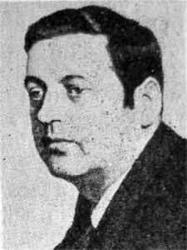
Yanis Sudrabkalns
 Latvia
- Early Life and Education
- Military Service and Early Writing
- Activities in the 1920s and 1930s
- World War II and Post-War Period
- Honors and Recognition
Early Life and Education
Arvīds Pēne was born on May 17, 1894, in Inčukalns, Latvia. His father, Kārlis Pēne, was a teacher who later became an innkeeper. In 1902, the family moved to Jaunpiebalga, the estate of the Sheremetev counts. The following year, Arvīds entered the church-parish school, graduating in 1908. He continued his studies at the Dubulti private gymnasium from 1909 to 1911.
Upon the death of his father in 1910, Arvīds was forced to discontinue his formal education and pursue knowledge independently. In 1913, he moved to Riga, where he began "a hungry and cheerful, difficult and wayward reckless life among young poets and artists."
Military Service and Early Writing
In 1915, Arvīds was mobilized into the army. After completing three-month medical courses, he served in the 302nd Surazh Infantry Regiment. In March 1917, as part of the 5th Latvian Rifle Regiment, he was assigned to the newspaper "Brīvais strēlnieks" ("Free Rifleman"), later renamed "Latvju strēlnieks" ("Latvian Rifleman").
In early 1918, Arvīds was demobilized due to health reasons. Returning to Riga, he worked as a proofreader for the newspaper "Līdums" ("Enlightenment") and published his first humorous poem, "Pavasara zaļais karogs" ("Spring Green Banner"), under the pseudonym Oliveretto on May 4, 1918.
Activities in the 1920s and 1930s
During the Latvian Soviet Republic from January to May 1919, Arvīds worked as a translator for the newspaper "Cīņa" ("Struggle"). Throughout the 1920s and 1930s, he held various positions in publications such as "Latvijas Sargs" ("Latvian Guard"), "Latvijas Vēstnesis" ("Latvian Herald"), "Hallo" ("Hello"), "Pēdējā brīdī" ("At the Last Moment"), "Dienas lapa" ("Daily Page"), and "Jaunākās ziņas" ("Latest News").
Arvīds also actively translated, wrote theater and music reviews, and composed essays on Latvian, German, English, Russian, and Italian literature. These essays demonstrated his profound and clear understanding of artistic and creative styles.
World War II and Post-War Period
In 1940, Latvia became part of the USSR, and Arvīds aligned himself with the Soviet regime. In June 1941, he attended the First Congress of the Union of Soviet Writers of Latvia. During the evacuation eastward at the outbreak of World War II, he resided in Kiров Oblast, wrote his famous poem "To the Russian People," and eventually settled in Bashkiria.
From January 1942 to September 1944, Arvīds lived in Moscow and forged friendships with Lithuanian and Estonian writers. In autumn 1944, he returned to Latvia and actively engaged in public and political activities.
Honors and Recognition
Arvīds Sudrabkalns (the name he adopted in 1925) received numerous honors and accolades throughout his life. He was named a People's Poet of the Latvian SSR in 1947 and a Hero of Socialist Labor in 1974. He was also awarded the Stalin Prize in 1948 and served as a member of the Central Committee of the Latvian Communist Party from 1963 to 1971.
Sudrabkalns was elected to the Supreme Soviet of the USSR during the 7th and 8th convocations (1966-1974). He passed away on September 4, 1975, in Riga and was buried at the Rainis Cemetery. A memorial room dedicated to him is located in the "Sprundas" house near Salacgrīva.