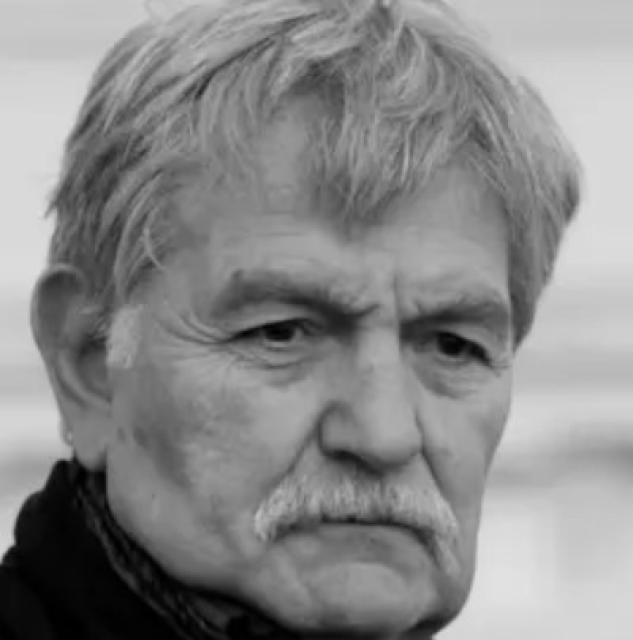
Yulian Panich
 Russia
- Julian Panich: A Life in the Arts
- Theatre and Cinema
- Film Directing
- Emigration and Life in the West
- Personal Life
- Death and Legacy
Julian Panich: A Life in the Arts
Early Life and Acting CareerBorn on May 23, 1931, in Zinovievsk, Ukraine, to a sanitary physician, Julian Panich embarked on his life's journey. He chronicled his experiences in his autobiography, "The Four Lives of Julian Panich, or The Wheel of Fortune," accompanied by archival photographs.
A precocious talent, Panich's artistic roots could be traced back to his grandfather, who transformed himself from a humble townsman into a second-guild merchant and patron of the arts. The theater he established hosted renowned performers such as Vera Komissarzhevskaya, Vasily Kachalov, Leonid Sobinov, Franz Liszt, and Fyodor Chaliapin.
From a young age, Panich immersed himself in theater. After high school, he briefly pursued a pedagogical degree but fate intervened. Inspired by the encouragement of Roland Bykov, Yuri Yakovlev, and Vladimir Etush, he auditioned for the prestigious Shchukin Theatre Institute.
Theatre and Cinema
Upon graduating from the Shchukin Institute, Panich joined the Moscow Lenin Komsomol Theatre, where he made his debut in "The Wheel of Fortune." After a stint at the Theater-Studio of Film Actors, he moved to Leningrad and established himself at the Pushkin Academic Drama Theatre under the esteemed direction of Georgy Tovstonogov.
Panich's versatility extended to multiple theaters in Leningrad, including the Lenin Komsomol Theatre and the Theatre of Drama and Comedy. His success continued on screen, with notable roles in films such as "Different Fates," "Pedagogical Poem," "About My Friend," "Stepan Kolchugin," and "Beware, Grandma!"
Film Directing
In the mid-1960s, Panich transitioned to directing, co-founding the Leningrad television studio "Lentelefilm." From the late 1960s until his emigration, he held the same position at the "Ekran" association on Soviet Central Television.
Panich's directorial work encompassed war dramas ("Road Home"), melodramas ("Farewell White Nights"), film adaptations ("Ballad of Cyrano"), and musical films ("... and Hour of Variety"). His wife, Lyudmila Panich, collaborated on several of these projects.
Emigration and Life in the West
In 1972, Panich emigrated with his family to Israel, intending to pursue filmmaking. However, a twist of fate led him to West Germany three weeks later.
Radio Liberty in Munich became Panich's new home after he encountered Aleksandr Solzhenitsyn's "Nobel Lecture." He introduced countless listeners to uncensored Russian literature, including works by Grossman, Erofeev, Maksimov, Vladim, and Voinovich.
While in exile, Panich recorded over a thousand programs, starred in several films, and co-founded the "Freedom Theater Hall." He staged plays in the United States and Germany, eventually acquiring American citizenship and settling in France.
Personal Life
Panich married twice, both times to students of the Shchukin Institute. His first marriage was to Yulia Gendelstein, and his second, in 1956, was to Lyudmila Zwey, who gave birth to their son, Igor.
Igor Panich pursued a multifaceted career in acting, directing, producing, and writing, earning the moniker "Russian John Grisham." He married Maria Romanova, a Parisian model who later became a philologist, and they had two children, Anastasia and Maximilian.
Death and Legacy
Julian Panich passed away at the age of 92 in Antibes, France, on October 9, 2023. The cause of death was not disclosed. His distinctive voice on Radio Liberty will forever be etched in the memories of those who listened.


