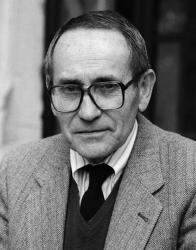
Yuri Nagibin
 Russia
- Early Life and Education
- Military Service and Wartime Writings
- Post-War Journalism and Literary Success
- Film and Television Contributions
- Later Years and Legacy
Early Life and Education
Yuri Markovich Nagibin was born in Moscow in 1920, into a family of a civil servant. His childhood was marked by the divorce of his parents, and he remained with his mother, who instilled in him "the foundational qualities of his human and creative personality."
Nagibin briefly considered a career in football but discovered his writing talent at his stepfather's suggestion. After a failed attempt at a short story, he became captivated by the process. Despite his mother's wishes, he enrolled in medical school, but soon transferred to the screenwriting faculty at VGIK.
Military Service and Wartime Writings
In 1940, Nagibin's first short story was published. However, his studies at VGIK were interrupted by the outbreak of World War II. He joined the front as a translator due to his proficiency in German and later participated in combat.
His wartime experiences became the inspiration for his military stories, published in the collection "Man from the Front" (1943). He joined the Writers' Union and covered the war as a correspondent for "Trud" newspaper.
Post-War Journalism and Literary Success
After the war, Nagibin pursued journalism while continuing to write prose. His short stories "The Pipe" and "Winter Oak" gained widespread popularity. In the mid-1950s, he published several collections, including "Man and Road" and "Pure Ponds."
Inspired by a hunting trip to the Meshchera region, Nagibin developed a fascination with its natural beauty and its impact on human lives. His subsequent works, such as "Pursuit: Meshchera Stories" (1963), further explored this theme.
Film and Television Contributions
In addition to his literary pursuits, Nagibin made significant contributions to film and television. He penned screenplays for notable films like "The Chairman" (1964), "Red Tent" (1969), and "Tchaikovsky" (1970). For television, he produced documentaries on the lives and works of Russian cultural figures, such as Lermontov, Aksakov, and Golubkina.
Later Years and Legacy
Nagibin continued writing until his death in 1994. His posthumously published autobiographical works, "Darkness at the End of the Tunnel" and "My Golden Mother-in-Law," provided further insights into his life and experiences. Nagibin's legacy as a prolific writer, screenwriter, and journalist endures in his diverse body of work that spans multiple genres.