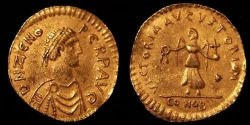
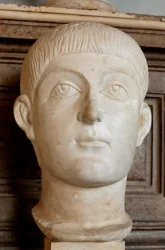
Zeno
Rise to the imperial court
Zeno was a fifth-century emperor of the Eastern Roman Empire, later known as the Byzantine Empire. Born in Isauria in southern Asia Minor, he was originally known by another name and rose through military service at the imperial court. His influence increased under Emperor Leo I, who relied on Isaurian soldiers to counterbalance powerful Germanic commanders.
Zeno married Leo’s daughter Ariadne and became connected to the imperial family. Their son, Leo II, inherited the throne as a child after Leo I’s death in 474. Leo II soon made his father co-emperor, and after the boy’s death that same year, Zeno became sole ruler.
Revolt and restoration
Zeno’s Isaurian background and promotion of fellow Isaurians stirred resentment among Constantinople’s political elite. In 475, a conspiracy led by Empress Verina and her brother Basiliscus forced him to flee the capital. Basiliscus took the throne, while Zeno returned to his homeland and gathered support.
The usurper’s government soon lost backing, including from important military allies. In 476, Zeno regained Constantinople and restored his rule. That same year, the last western emperor, Romulus Augustulus, was deposed in Italy. Zeno remained emperor in the East and dealt with the new realities of a western empire ruled by Germanic leaders, including the commander Odoacer.
His later years were marked by further rebellions and negotiations with powerful generals. Zeno sought to secure the eastern frontier and manage competing factions within the empire. Religious disagreement also shaped his reign. In 482, he issued the *Henotikon*, a compromise intended to ease disputes between Christians who accepted the Council of Chalcedon and those who rejected its definition of Christ. The measure failed to unite the churches and contributed to a lasting break between Rome and Constantinople known as the Acacian Schism.
Legacy
Zeno died in Constantinople in 491 after ruling for nearly seventeen years, including the interruption by Basiliscus. His reign was often portrayed by hostile sources as chaotic, but he successfully recovered power and kept the Eastern Empire intact through a period of profound change. His government navigated civil conflict, religious division, and the political transformation of the former western provinces.
Zeno’s tenure illustrates how the Eastern Roman state adapted after imperial authority in the West collapsed. Though remembered for revolts and controversy, he maintained a durable regime and left the empire to his successor, Anastasius I.